



News:
Spotlight Content
Posted: June 27, 2025
Chestnut Hill Realty celebrates opening of the 250-unit Benjamin Franklin
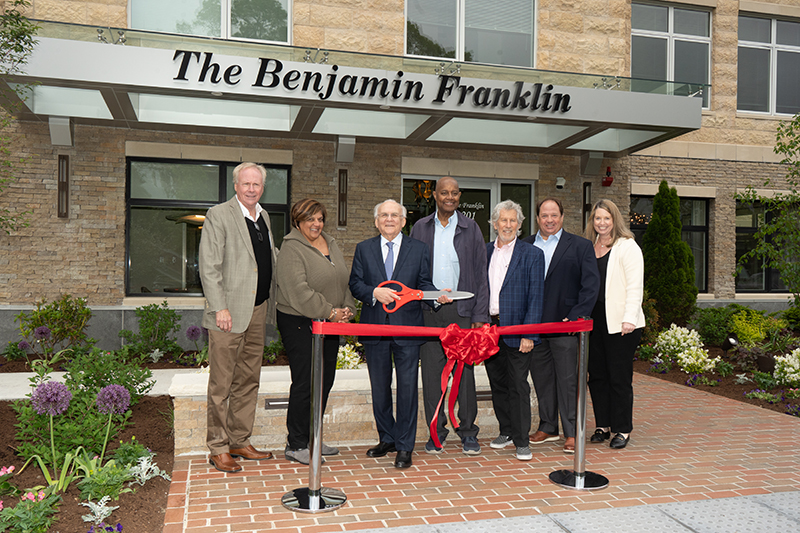
MassDevelopment; Ed Zuker, founder and CEO, CHR; Bernard Greene, town of Brookline select board; Chris Rogers,
vice president of development and construction CHR and Jen Murphy, chief operations officer, CHR.
Brookline, MA Chestnut Hill Realty (CHR) celebrated the official opening of the Benjamin Franklin Building on May 21st, marking the culmination of multiple years of work as Chestnut Hill Realty pursues its goal of increasing the availability of housing in the Boston area. CHR also reinforced its commitment to the community at the ceremony by donating $10,000 to the local Baker School.
The Benjamin Franklin Building is part of a 461-unit project called the Residences of South Brookline (ROSB) that is developed under the Commonwealth’s Chapter 40B statute to help fill the region’s critical housing shortage and affordable housing needs. Recent expansions included the 127-unit Adams Building in 2023, and the 36-unit Bartlett Building and 48 additional townhomes in 2022. In all, 91 of the 461 units are designated as affordable, expanding the local housing options for individuals, couples and families.
One of New England’s largest residential real estate companies specializing in multi-family housing for more than fifty years, Chestnut Hill Realty held a ribbon cutting to mark the opening of a 250-unit apartment building in Hancock Village. The Benjamin Franklin Building represents the culmination of a multi-year development plan to modernize and expand the 100-acre Hancock Village, home to more than 3,000 residents. With 20% of the residences in the eight-story Benjamin Franklin Building designated as affordable, the building significantly expands local housing options.
Tags:
Spotlight Content
MORE FROM Spotlight Content

New England Real Estate Journal's 2026 Women in Commercial Real Estate Spotlight
NEREJ's Women in CRE Spotlight celebrates the women making an impact across commercial real estate and the companies that recognize, support and champion them.








.png)
Columns and Thought Leadership

How do we manage our businesses in a climate of uncertainty? - by David O'Sullivan
These are uncertain times for the home building industry. We have the threat of tariffs mixed with high interest rates and lenders nervous about the market. Every professional, whether builder, broker, or architect, asks themselves, how do we manage our business in today’s climate? We all strive not just to succeed, but

Limited supply fuels landlord‑friendly conditions in Rhode Island’s industrial market - by Julie Freshman and George Paskalis
As we enter the spring of 2026, the Rhode Island industrial real estate market stands on stable footing, following several years of resilience fueled by constrained supply, steady demand, and dynamic economic conditions.

As legacy names recalibrate, new entrants are moving in with fresh capital, new technologies, and business models tailored to today’s supply-chain needs - by Michael Harrington
Southern New Hampshire’s industrial market has always punched above its weight. For decades, the region has attracted a mix of advanced manufacturing, beverage and food producers, logistics operators, and specialty

Shallow-bay wins on 495/128: A renewal-driven market with a thin pipeline - by Nate Nickerson
The Boston industrial market entered mid-2025 in a bifurcated state. Large-block vacancy remains elevated, while shallow-bay along the 495/128 corridor continues to prove resilient. Fieldstone’s focus on this geography positions us squarely in the middle of a renewal-driven, supply-constrained
