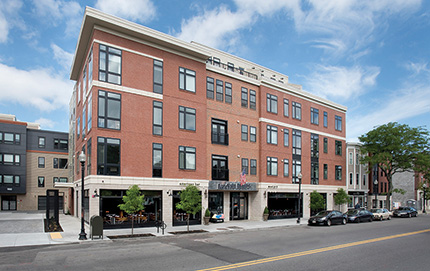



South Boston, MA O’Sullivan Architects, Inc. designed a 67,000 s/f, 5-story mixed-use, retail and 33-unit luxury residential condominium building at 170 West Broadway for KEMS Holding Corp./170 West Broadway, LLC. Although we are an architecture and design firm with a wide array of abilities, we believe the work that best expresses our talents is larger, mixed-use commercial and residential developments. The project team was led by David O’Sullivan, AIA, principal-in-charge with Donnie Garrity, LEED AP, project manager and design architect, and assistance from Joseph Walsh, senior project manager, LEED AP – construction specifications, Janice Gorman, LEED AP ID&C, senior interior designer for lobby and common spaces, and Erion Nikolla, job captain assisted with marketing graphics for the client’s pre-sales campaign.
Edward Doherty, president of KEMS Holding Corp. said he was “very glad we chose O’Sullivan Architects for the level of service and involvement from project conception through construction and marketing.”
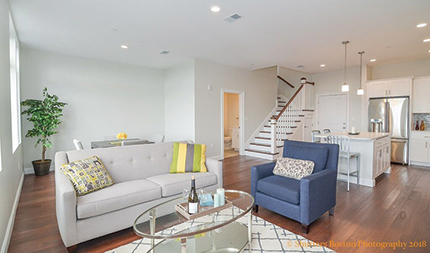
The four upper levels of the building, situated above street level retail/restaurant space, comprises 40,500 s/f of residential with a mix of one and two bedroom units. The 4th and 5th level penthouse of the new building includes two-level duplex units with dedicated roof terraces situated behind the parapet wall. Four of the residential units are designated as affordable. Beneath the building included two levels of underground garage parking.
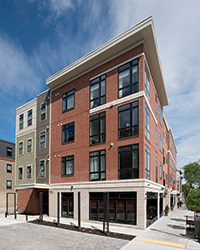
The massing of the new building was developed with site planning strategies and the existing neighborhood aesthetic of the community in mind. As part of the outreach process, 170 West Broadway was redesigned with an 8-foot setback at the 5th (penthouse) level resulting in an apparent 4-story building along this streetscape. The new building then steps down to 2½ stories facing Athens St. at the rear, complementing the scale of the residential structures along that street.
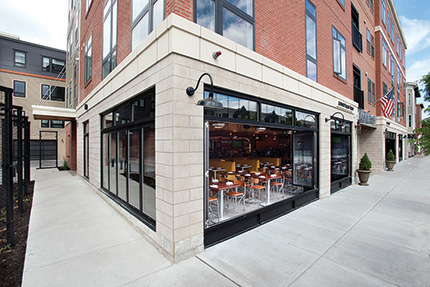
The individual elevations allow different architectural elements to further balance the neighborhood scale. The use of material changes and window styles and rhythms, help break the length of the facades. The use of horizontal banding and material changes help break down the height while giving this new development a unique personality. For example, a familiar mix of exterior cladding materials, masonry detailing of the facades along West Broadway and Gardner Place, and a mix of fiber cement panel, lap, and trim siding for the building portions closer to Athens St., are all exterior characteristics cherished in South Boston. The restaurant space uses a mix of contemporary masonry and aluminum storefront systems and styles consistent in form to the rest of the building façade composition. The entire row of sidewalk windows allow for an al fresco dining experience.
O’Sullivan said “we worked very closely with Ed Doherty and his team during the entire process and are so pleased with the building and the success our client has achieved with the project.”
The success of the project can be measured by the numbers: over 90% of the residential units were sold prior to completion and within a few months of the occupancy permit 100% have been sold. O’Sullivan Architects is very proud of having served as a critical member of the project team in the completion of this new mixed-use development at 170 West Broadway. O’Sullivan Architects was engaged from the early permitting stages, to design development, construction documents, and construction observation until completion. O’Sullivan Architects continues to work with the developer, KEMS Holding Corp. and currently have several more projects in Boston and Cambridge, in construction or in final stages of planning and permitting.
Helical Drilling designed and installed a secant pile excavation support system that addressed all subsurface/zero-lot-line challenges and served as the permanent structural basement foundation wall system. Key benefits of the secant pile wall solution included: substantial net cost savings, eliminated concerns with construction vibrations, provided groundwater cutoff, provided shoring and protection of adjacent existing structures, and expedited the construction schedule.
KEMS Holding Corp. - developer
O’Sullivan Architects - architect
Veitas and Veitas Engineers - structural engineer
Helical Drilling - geotechnical design/build
Photo credits: Shelly Harrison Photography and Shutters Boston Photography.









As we enter the spring of 2026, the Rhode Island industrial real estate market stands on stable footing, following several years of resilience fueled by constrained supply, steady demand, and dynamic economic conditions.