


 (1).gif)
News:
Finance
Posted: April 9, 2008
It's really not all doom and gloom; there is light!
For the next few minutes, if you take the time to read this, I'd like to summarize what is happening statistically around the country and more particularly New England.
On February 28th the Office of Federal Housing Enterprise and Oversight (OFHEO) published their fourth quarter 2007 report with the headline "Widestpread House Price Decline In Fouth Quarter - Pockets of Strength Remain; Coasts, Midwest Show Biggest Declines." According to the information, the Home Price Index (HPI) showed a 1.3% decline over the third quarter, which showed a .3% decline over the second quarter. Is this enough to make one tremble? Hardly!
Let's look a little further into the information in the study. OFHEO has produced this study for many years with 1980 serving as the base year, with the first quarter = 100. The statistics compiled are quite interesting. By 1985 New England had surged ahead of the rest of the country's other eight segments to 170.78. The average for the country was 123.82. New England continued its front running pace climbing to 291.72 in 1989. Then, as some of us recall, the sky fell in. As the recession took hold the HPI declined with New England tumbling to a low of 252.35 in 1994 - a significant decline of 13.5% from its height in 1989. Beginning in 1994 things began to accelerate with New England climbing at a near break neck pace. By 2000 the HPI was up to 366.06 while the average for the country was 240.78. By the end of 2005 the HPI had climbed to 612.07, representing a 67% increase. The country was averaging 365.54 and don't forget, a large portion of the increase for the country was the result of New England's performance. We peaked at 624.25 in the first quarter of 2007 and dropped back to 615.05. Yes, we have experienced a decline in our HPI, albeit a very small and almost insignificant drop in the face of the increases since 1980. The S & L debacle and recession of the early 1990s caused far greater problems than what has been encountered currently.
Yes the "doom and gloomers" say the other shoe has yet to drop and that foreclosures will accelerate and property values will continue to decline. Probably all true but again, look at where we've come from. Perhaps this downturn will help bring a bit of reason back into home prices, but I doubt it. The problem markets that are most heavily impacted by the 'sub-prime' loans are suffering significant losses, which was also the case in the early 1990s. The stronger, more desirable markets are sailing along, helped in part by the lowering of mortgage rates.
A study of MLS reports for all single family home sales in Mass. produced more interesting stuff. For 2006 the total number of sales was 42,162 and for 2007 it was 41,010, or a decline of 2.7%. Average days on market increased from 118 to 134 and the average price for 2006 was $427,032 versus $428,395 for 2007. The first quarter of 2008 shows 5,761 sales with an average price of $392,615 and an average of 153 DOM. All in all one could glean from the above is that whether we want to call it a recession or not, we are in a period of decline. It does not appear that it will be prolonged in spite of ever increasing oil prices.
The stock market appears to be relatively positive and forecasts are somewhat optimistic, despite a mixed bag of prognostications. This is a difficult market to endure and many professionals are leaving it looking for a more stable work environment. Having been appraising since 1974, I only add that this is not the first downturn nor will it be the last. Hopefully we can all hang in, ride it through and come out on the other side.
Steve Elliott is president of Elliott Gottschalk & Assoc., Boston, Mass.
MORE FROM Finance
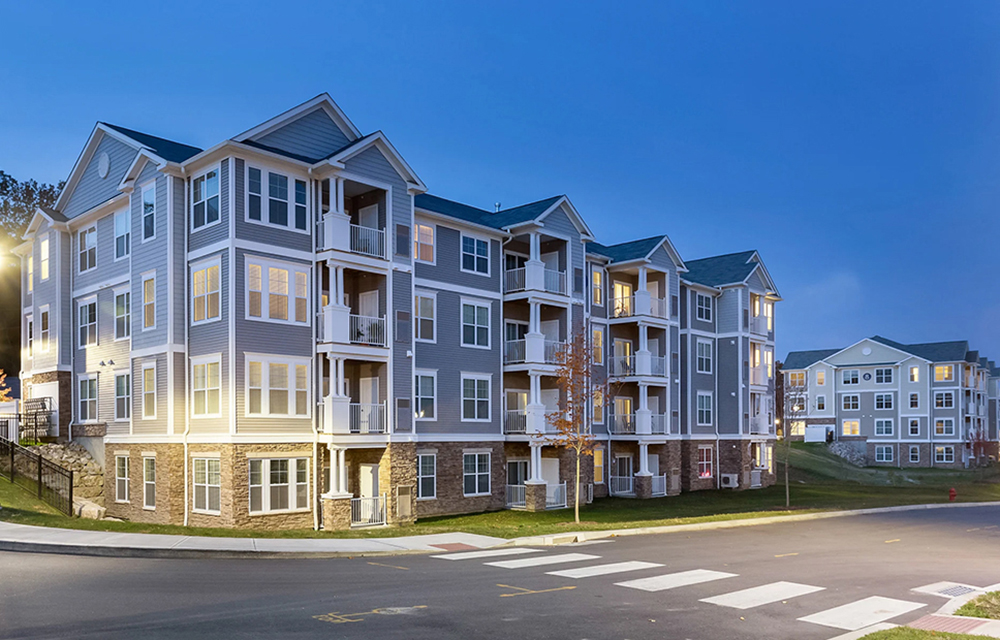
Kozlowski of Newmark Capital Markets secures $115.6 million financing for two properties in CT
East Lyme, CT Newmark has arranged $115.6 million in financing on behalf of the sponsor to refinance The Cove at Gateway Commons and Sound at Gateway Commons. Newmark Capital Markets Strategies managing director Avi Kozlowski secured the financing through Freddie Mac.




 (1).gif)


Quick Hits


Columns and Thought Leadership

Massachusetts real estate transfers over $1 million face new tax rules as of November 1st - by Daniel Meyer
Attention to owners of real estate in the Commonwealth (and the title companies and other professionals who advise them), the Massachusetts Department of Revenue (the “DOR”) recently adopted a new “millionaire’s tax” via 830 CMR 62B.2.4

The focus on price per s/f compared to the comparable sales used in the appraisal report - by Dennis Chanski
Over the past several weeks, I have completed appraisal assignments for private clients. Interestingly, after submitting these appraisals, I received several phone calls – not to question the value, content, or any incorrect information, but rather to discuss the price per s/f compared to the comparable sales used in the report.

Are appraisers on the same page as the assessor? - by Richard Seman
The purpose of this article is to address problematic or confusing issues which may help assessors and appraisers to better understand how to value real estate for tax assessment purposes.

Reverse exchanges and the challenges of a competitive real estate market - by Michele Fitzpatrick
Our current, highly competitive real estate market poses specific challenges for investors who are considering taking advantage of a tax-deferred 1031 exchange. In this market, investors will have no problem selling their current property if priced properly, but they may find it difficult to find a suitable replacement property
