


 (1).png)
News:
Owners Developers & Managers
Posted: September 18, 2026
Healey-Driscoll Administration seeks developer to transform former 72-acre school into 288+ home neighborhood
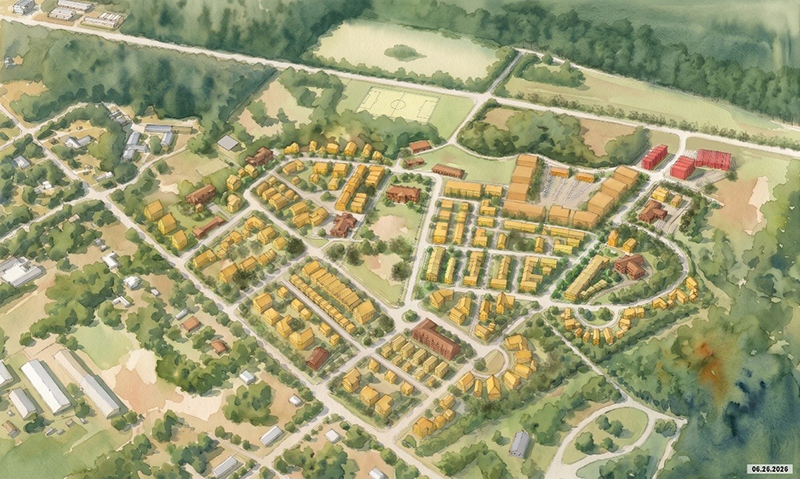
Lancaster, MA According to the Healey-Driscoll Administration, the Division of Capital Asset Management and Maintenance (DCAMM) has released a Request for Proposals seeking a developer to transform the 72-acre former Lancaster Industrial School for Girls property into a new, walkable neighborhood with at least 288 homes.
The redevelopment will be guided by a community-informed plan developed with the Town of Lancaster and will include a mix of housing, public spaces and potentially neighborhood-serving commercial uses. Depending on future local approvals, the site could ultimately support up to 386 homes.
“We created State Land for Homes because Massachusetts has underused public land that can and should be helping us build the housing people need,” said governor Maura Healey. “This project is a great example of what that looks like. We’re taking a large state-owned property that has sat vacant and putting it back to work to create hundreds of new homes, while building on the vision developed with the Lancaster community.”
“Building more homes is one of the most important things we can do to make Massachusetts more affordable,” said lieutenant governor Kim Driscoll. “By working with Lancaster from the beginning, we have a plan that can turn this property into a neighborhood with different housing options, walkable public spaces and opportunities for local businesses.”
The RFP seeks qualified development teams to redevelop the historic campus in accordance with a Regulating Plan developed by Speck Dempsey, a planning and urban design firm, in collaboration with DCAMM and the Town of Lancaster. The plan emphasizes walkability, a range of housing options, active public spaces, historic preservation and high-quality architectural design.
The Regulating Plan was developed through an extensive public engagement process between summer 2025 and spring 2026. DCAMM and Speck Dempsey held three community meetings, an open design studio and two pop-up outreach events to gather feedback from residents and local leaders. Proposals submitted through the RFP must conform to the plan and reflect the architectural character developed through that process.
“The Lancaster Industrial School occupies a beautiful site with some lovely historic buildings, specimen trees and mighty hedgerows, but, more than that, deeply intelligent traces: roads and paths laid out at a time when there was a more natural sense of topography and placemaking. By embracing these roads and paths, preserving almost every majestic tree and hedgerow, and organizing itself around its best historic buildings, the plan creates a place of unique character while minimizing infrastructure costs and ecological impact,” said Chris Dempsey and Jeff Speck, co-founders of Speck Dempsey.
Under the Affordable Homes Act, the site is authorized for at least 288 homes as-of-right. The Regulating Plan also envisions the potential for additional housing and neighborhood-serving retail and commercial uses along a walkable main street.
If additional local approvals are secured through rezoning or an agreement between DCAMM, the Town of Lancaster and the selected developer, the project could ultimately include up to 386 homes as well as commercial uses that support an active mixed-use neighborhood.
“This redevelopment will turn long-vacant state property into new homes, creating a new neighborhood for Lancaster residents and putting the land back on local tax rolls,” said Juana Matias, secretary of the executive office of housing and livable communities. “This is exactly the kind of transformation that Governor Healey's Affordable Homes Act was designed to unlock, and we're proud to help bring this project to life.”
DCAMM, in consultation with the Executive Office of Housing and Livable Communities (EOHLC), anticipates selecting a development team in late 2026 or early 2027. Following selection, the property is expected to transfer to the developer within approximately 18 months, with construction beginning thereafter.
“This is one of the most spectacular sites in the entire State Land for Homes portfolio,” said DCAMM commissioner Adam Baacke. “As a result of an unparalleled collaboration with the Lancaster community and Speck Dempsey, the development enabled by the Regulating Plan will complement the strength of the setting with a thoughtful combination of new development, historic preservation, and protection of significant natural landscape features that will combine to create a neighborhood we will all be truly proud of.”
DCAMM will continue working closely with the town of Lancaster as the project advances and anticipates the town will consider proposed rezoning this fall to allow for additional housing and neighborhood-serving commercial uses. That process will include public hearings and consideration by Town Meeting.
“The Town of Lancaster has been working closely with the State and its consultants for over a year to understand the type of development that could occur on this property,” said Jason Allison, chair of the Lancaster Select Board. “The resulting regulating plan incorporates numerous suggestions by the Town's residents on how to honor the site with a thoughtful, unique development.”
The Lancaster redevelopment advances the Healey-Driscoll Administration’s State Land for Homes initiative, which transforms underused state-owned property into new housing. Since Governor Healey launched the initiative in 2025, the Administration has advanced plans for more than 5,600 homes across nearly 700 acres of state-owned land in 33 Massachusetts communities.
MORE FROM Owners Developers & Managers

Recognizing mayor Grebien’s legacy of development and partnership - by Gaetan Kashala
As Pawtucket looks toward new leadership following Adam Greenman’s victory in the September 9 Democratic primary, The Pawtucket Foundation extends its appreciation to mayor Donald Grebien for nearly 16 years of service



Quick Hits


Columns and Thought Leadership

The legislature has spoken: New Hampshire doubles down on housing in commercial zones - by John Sokul
Last year, the New Hampshire Legislature enacted HB 631, a landmark housing measure requiring municipalities to permit multifamily housing in commercially zoned districts. The law generated

Revitalized Town Centers: Retail??? - by Carol Todreas
It is now widely accepted that customers want to shop in person at physical stores. Brands know that they do better business in a physical store than just on line so they want to open stores. Demand for retail space by digital merchants, local entrepreneurs, and newly developed national chains

IREM president’s message: Our new reality - Staying ahead of supply chain delays - by Yoany Vargas
Supply chain delays are slowing construction, ratcheting up operating costs, and extending turnover timelines across Greater Boston, directly reducing revenue and increasing the workload for multifamily and
Retail infill strategy to activate Pawtucket’s Conant Thread District - by Gaetan Kashala
Until recently, the Conant Thread District consisted of approximately 150 acres of underutilized industrial land spanning Pawtucket and Central Falls. Today, the area is one of the most significant