


 (1).png)
News:
Owners Developers & Managers
Posted: March 12, 2026
The next evolution of residential amenities: Turning wellness into a measurable asset
Across the multifamily housing sector, amenities have long been a central part of the leasing and marketing strategy. Fitness centers, yoga studios, and wellness spaces appear in nearly every new development, yet many of these spaces remain underutilized. Equipment sits idle, programming is inconsistent, and property teams often lack the resources to fully activate these environments.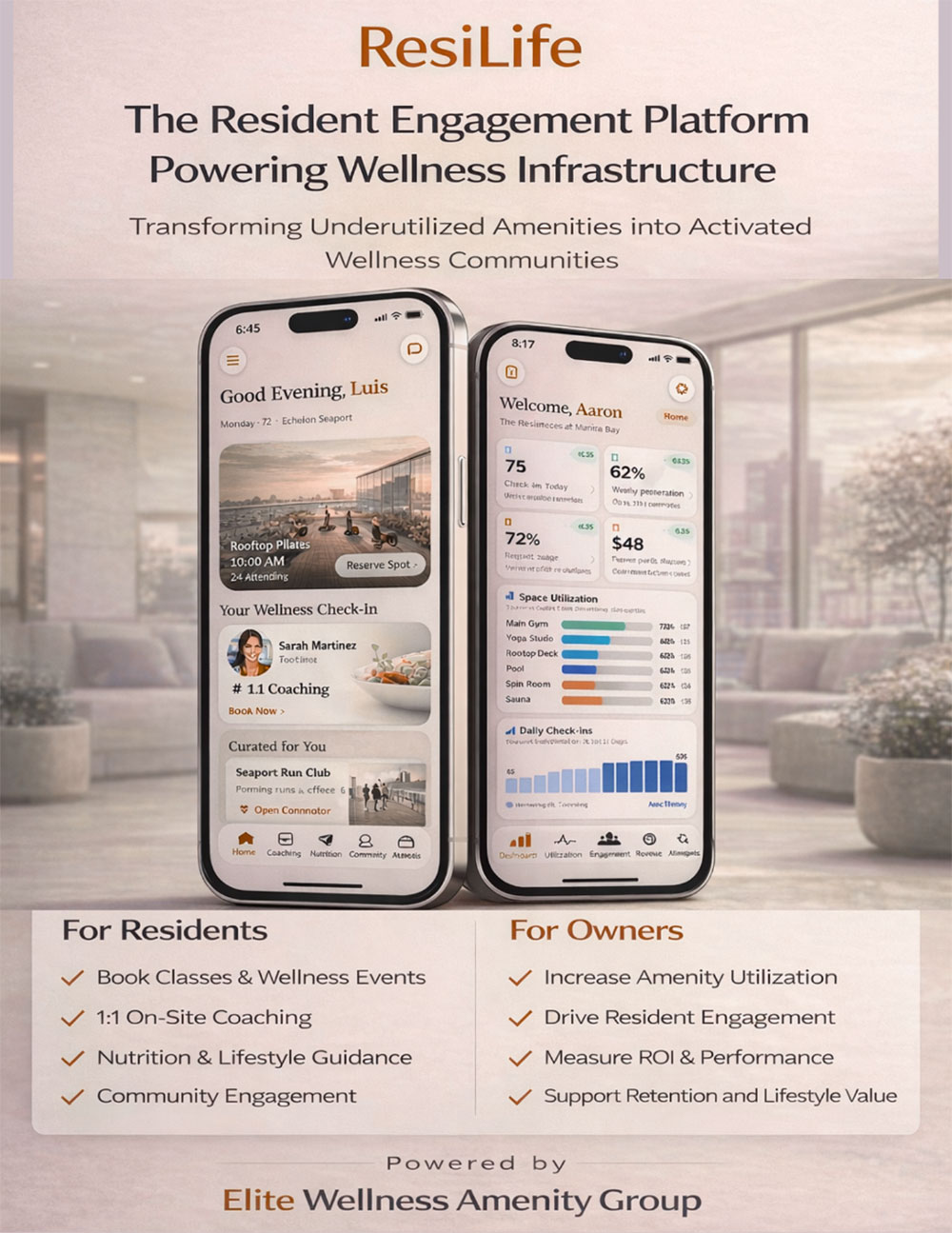
As resident expectations continue to evolve, owners and operators are beginning to view wellness amenities differently — not simply as marketing features, but as operational assets that can influence resident retention, community engagement, and long-term property performance.
This shift has given rise to a new category of amenity management focused on activation, programming, and measurable outcomes.
Elite Wellness Amenity Group (EWAG) was created to address this gap by helping multifamily communities transform existing fitness spaces into fully managed wellness environments that drive engagement and deliver real operational value.
The Elite Wellness Amenity Group (EWAG) was established as a direct response to a significant and persistent gap in the multifamily housing market. This gap involved the underutilization and under-performance of existing on-site fitness facilities, which often failed to truly engage residents or contribute meaningfully to a property’s overall operational success and resident retention goals.
EWAG’s core mission is to fundamentally transform these dormant or basic fitness spaces into fully managed, vibrant, and integrated wellness environments. This transformation goes far beyond simply upgrading equipment; it involves a holistic approach encompassing professional facility management, curated programming, cutting-edge technology integration, and expert staffing. By implementing this comprehensive strategy, EWAG drives meaningful resident engagement, fostering a true sense of community and well-being within the property. The result is a demonstrable delivery of real operational value for multifamily communities, translating into enhanced resident satisfaction, higher retention rates, and a powerful, marketable amenity that differentiates the property in a competitive real estate landscape.
A new model for amenity activation
Traditionally, multifamily fitness centers have been treated as self-service amenities. Developers invest heavily in equipment and design, but ongoing activation is often minimal. Without structured programming or dedicated staffing, these spaces frequently fail to deliver the engagement levels owners originally envisioned.
Elite Wellness Amenity Group approaches this differently. The company operates as a wellness amenity management partner, providing staffing, programming, operations, and resident engagement strategies that transform fitness areas into fully activated wellness hubs.
Rather than relying on property teams to coordinate vendors or manage programming, EWAG provides an integrated service model that includes:
- Certified trainers and wellness staff
- Resident fitness programming and classes
- Personal training services
- Community wellness events
- Equipment oversight and maintenance
- Resident engagement campaigns
The result is a wellness environment that operates more like a hospitality service than a passive amenity.
Introducing the ResiLife infrastructure platform
At the center of the EWAG ecosystem is ResiLife, a wellness infrastructure platform designed specifically for residential real estate.
ResiLife provides owners and operators with real-time visibility into how wellness amenities are actually being used within their communities. Through the platform, property teams can monitor key engagement indicators such as amenity activation levels, participation rates, resident engagement trends, and overall wellness programming performance.
For owners and asset managers, this level of insight is particularly valuable. Amenities are a major capital investment in modern developments, yet historically there has been little data available to measure their effectiveness.
ResiLife changes that by providing actionable data that allows operators to understand:
- How often residents are using wellness amenities
- What types of programming generate the highest engagement
- When activation levels are strongest throughout the year
- How community participation impacts overall resident experience
This data-driven approach allows wellness programming to evolve based on resident behavior rather than assumptions.
Why wellness matters for modern multifamily communities
Over the past decade, the role of wellness in residential living has expanded significantly. Residents increasingly view health, fitness, and lifestyle experiences as an important part of where they choose to live.
Amenities are no longer simply features within a building. They are part of the overall living experience.
When wellness amenities are actively programmed and professionally managed, they can contribute to stronger resident relationships, more vibrant community culture, and a higher perceived value of the property itself.
Activated wellness spaces often become natural gathering points within a building, encouraging interaction between residents and creating the kind of community engagement that traditional amenities rarely achieve on their own.
For owners, this translates into an amenity strategy that supports retention, strengthens community identity, and enhances the overall lifestyle offering of the property.
Reducing operational burden for property teams
Another challenge for multifamily operators is the growing operational complexity of modern amenities. Property teams are responsible for a wide range of responsibilities, and managing wellness programming often falls outside their core expertise.
EWAG’s management model removes that burden by handling the full operational scope of the wellness environment — from staffing and scheduling to programming and resident engagement.
This turnkey approach allows property managers to offer a highly activated wellness amenity without adding additional operational demands to their teams.
Looking ahead: Wellness as infrastructure
As the multifamily industry continues to evolve, wellness amenities are likely to play an increasingly strategic role in how residential communities differentiate themselves.
Rather than simply building fitness spaces, forward-thinking owners are beginning to view wellness as infrastructure an integrated system that supports resident lifestyle, community engagement, and long-term property performance.
Through its combination of operational management and the ResiLife infrastructure platform, Elite Wellness Amenity Group is working to help owners unlock the full potential of these spaces.
In a market where resident expectations continue to rise, the difference between having an amenity and fully activating it may ultimately determine how much value that space truly delivers.
MORE FROM Owners Developers & Managers

The Lodge at Spruce Peak recognized with Condé Nast Traveler’s 2026 Readers’ Choice Award - #3 in New England
Stowe, VT Condé Nast Traveler revealed the results of its annual Readers’ Choice Awards, with The Lodge at Spruce Peak recognized as the #3 U.S. Resort in New England.







Columns and Thought Leadership

Retail infill strategy to activate Pawtucket’s Conant Thread District - by Gaetan Kashala
Until recently, the Conant Thread District consisted of approximately 150 acres of underutilized industrial land spanning Pawtucket and Central Falls. Today, the area is one of the most significant

Revitalized Town Centers: Retail??? - by Carol Todreas
It is now widely accepted that customers want to shop in person at physical stores. Brands know that they do better business in a physical store than just on line so they want to open stores. Demand for retail space by digital merchants, local entrepreneurs, and newly developed national chains

The legislature has spoken: New Hampshire doubles down on housing in commercial zones - by John Sokul
Last year, the New Hampshire Legislature enacted HB 631, a landmark housing measure requiring municipalities to permit multifamily housing in commercially zoned districts. The law generated

IREM president’s message: Our new reality - Staying ahead of supply chain delays - by Yoany Vargas
Supply chain delays are slowing construction, ratcheting up operating costs, and extending turnover timelines across Greater Boston, directly reducing revenue and increasing the workload for multifamily and