



News:
Construction Design & Engineering
Posted: December 18, 2020
Question of the Month: Is wastewater nitrogen impacting your business or environment? - by Pio Lombardo

Lombardo
Associates, Inc.
Wastewater nitrogen causing ecological havoc – Development can lead with innovation
The water quality damages associated with excessive nitrogen discharges to our surface and groundwaters are resulting in life threatening Harmful Algae Blooms (HAB), loss of shellfish and finfish and endangering the safety of our groundwater drinking water aquifers are now ubiquitous in the U.S. and worldwide. Wastewater nitrogen discharges are typically the elephant in the room when the sources of nitrogen are quantified. Septic nitrogen discharges, in particular, are the primary cause of water quality-ecological degradation in many, especially coastal, areas.
Locally, Cape Cod, Martha’s Vineyard, NH’s Great Bay, CT coastal communities and Long Island have exhibited this wastewater nitrogen destruction of aquatic resources with significant adverse impacts. The damage is widespread in Florida where springs and rivers are no longer viable for recreational and aquatic resources. The Conservation Law Foundation, who were instrumental in the Boston Harbor cleanup, announced it plans to sue Cape Cod towns to get the septic nitrogen issue addressed and “demands a temporary suspension of any new septic systems and system inspections that support sales of properties that use septic on Cape Cod until this widespread problem can be fixed.”
Development can provide leadership in addressing this wastewater nitrogen challenge. As climate change concerns stimulated the use of zero energy (or even positive) energy buildings, development can provide zero, as well as positive, nitrogen impact. The tools exist and are cost-effective to achieve this objective. Conventional sewering is not cost-effective nor technically capable to achieve the required nitrogen removal requirements. Distributed (i.e. onsite and neighborhood/cluster) wastewater systems along with innovative groundwater treatment systems using Permeable Reactive Barriers (PRB) have demonstrated cost effectiveness, technical reliability and ability to achieve net positive nitrogen impact for the past 20 years throughout the Northeast states, as well as entire U.S.
As a point of reference, the state-of-the-art capability for sophisticated centralized wastewater treatment systems is to produce treated water with Total Nitrogen (TN) of 3 mg/L. On-site wastewater systems achieving effluent TN < 5 mg/L have been permitted in Mass. since 2001 with numerous installations in the Northeast as well as throughout the U.S. These systems have been vetted by numerous federal, state and county independent evaluations during the past 20 years demonstrating the ability to achieve an average TN of 3 mg/L. Neighborhood/cluster wastewater systems have demonstrated the ability to reliably achieve effluent TN of < 2 mg/L. One was recently permitted by the state of Utah for a hotel next to a National Park, with the requirement to achieve TN < 2.5 mg/L.
PRBs are a groundwater treatment technique in which the treatment system is placed in groundwater and nitrogen is removed from groundwater as the water naturally flows through the PRB. In 2005, a PRB was installed on Cape Cod and documented by a Woods Hole academic institution to be effective at nitrogen removal. For a new development, a PRB has been installed in Southampton N.Y. that along with a neighborhood wastewater system will remove more nitrogen than the project would discharge. This is achieved as the PRB will also remove groundwater nitrogen from other sites that discharge to groundwater. An attractive feature of a PRB technique is that it is a passive treatment system and will have a useful life of 40+ years. Beyond nitrogen removal performance monitoring there is no required operations & maintenance. In Conn. a DEEP permitted PRB was paired with a conventional treatment system to achieve 97% nitrogen removal and avoided the need for a wastewater treatment system and additional operations & maintenance.
While the above speaks to the water quality impact of wastewater nitrogen, the drinking water impact can be significant in areas that rely upon groundwater for their water supply. The drinking water public health standard requires that nitrate-nitrogen be < 10 mg/L. Many permits for wastewater systems that discharge into drinking water aquifers require effluent TN to be less than 10 mg/L. As a safety precaution some areas require effluent TN < 5 mg/L.
For many areas connecting to a sewer system for development or to address nitrogen contamination is not a viable option. As for many challenges, there are many opportunities for innovation to address wastewater nitrogen that can produce win-win situations for property owners and the environment.
In summary, there are many tools available to address the wastewater nitrogen challenge. Development can provide leadership in demonstrating how to achieve positive nitrogen impact outcomes. In many areas, demonstrating this leadership will be a requirement for project approvals.
Pio Lombardo, P.E. is president of Lombardo Associates, Inc., Boston, Mass.
MORE FROM Construction Design & Engineering
Nordblom partners with Erland Construction for new residential development in Dedham
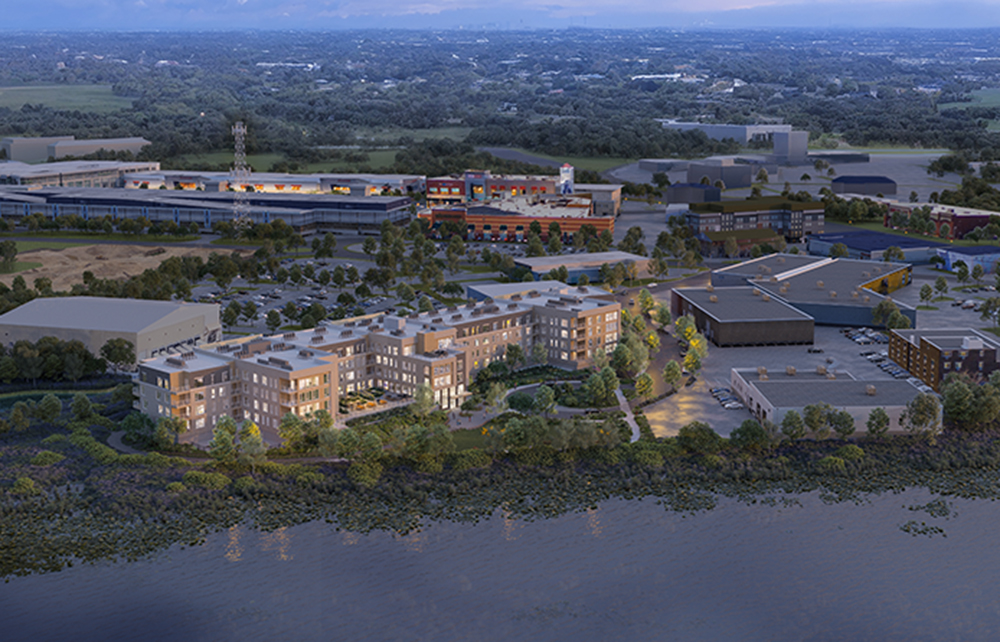
Dedham, MA Erland Construction has once again partnered with long-time client Nordblom Company to bring a new multifamily residential community, Vantage, to life. Working in collaboration with Stantec, Erland will construct a 218,000 s/f, four-story wood- and steel-frame building that will introduce 155 apartment homes to this rapidly growing neighborhood.






Columns and Thought Leadership

It’s time to lead: Confronting mental health in construction - by David Watts
As we close Mental Health Awareness Month, we must be clear: May isn’t just about ribbons, hashtags, or lunchtime mindfulness apps. It’s about responsibility to confront hard truths that linger in silence, and to challenge ourselves, as leaders in our industry, to do more.

Greenwood Credit Union City Hall Plaza nears completion - by Frank Picozzi
After several years of planning, construction, and anticipation, the community is eagerly awaiting the opening of the Greenwood Credit Union City Hall Plaza and outdoor skating rink later this month.

ABC-Mass. chairman’s message: Rent control isn’t the answer to our housing crisis - by Luiza Mills
As you may know, Massachusetts voters will be weighing in on a number of ballot initiatives in November. Among them is a proposal to impose the nation’s strictest statewide rent control policy. I’d like to tell you why the ABC MA Board

Navigating tariffs and material uncertainty in today’s construction market - by Karl Ginand and Tiffany Gallo
As headlines around tariffs seem to dominate the news daily, many considering construction projects have anticipated major cost escalations and widespread supply issues. While tariffs haven’t driven pricing spikes to the extent once feared, the lasting impact has been a new layer of uncertainty, affecting more than just budgets.
