


 (1).png)
News:
Owners Developers & Managers
Posted: April 28, 2017
A strong Boston economy means more traffic (2.0) - by Liz Berthelette

Traffic congestion remains a hot topic in Boston. As a follow up to our December 2016 blog post titled “A strong Boston economy means more traffic,” where NAI Hunneman’s research department examined the correlation between increasing commuting times and strong economic conditions, this post will highlight the potential costs of greater congestion.
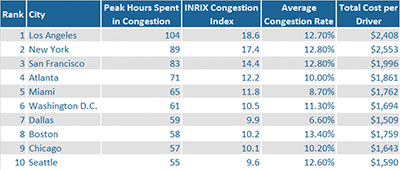
Boston is known to have some of the worst traffic congestion in the country and INRIX’s new 2016 Traffic Scorecard highlights just how congested this city is. Globally Boston is the 16th-most congested city with 58 peak hours spent in congestion. Compared to most metropolitan cities, Boston is on the smaller side with respect to population and size of the city. When comparing Boston’s population density throughout the nation, Boston is ranked 51st and taking into account the fact that the Massachusetts residents have access to an extensive commuter rail system and two interstate highways that go directly into the city, one would not expect there to be as much congestion as there is. Yet, Boston ranks 8th in peak hours in congestion (58 hours) and 3rd in average congestion rate (13.4%) among all major North American cities.
While traffic can be frustrating to commuters, there are both direct and indirect costs associated with this increased congestion. Direct costs include the value of fuel and time wasted in congestion while indirect costs include the increase in prices to households from freight trucks sitting in traffic. As expected, Boston ranks 6th in the country with a total cost per driver of $1,759 annually.
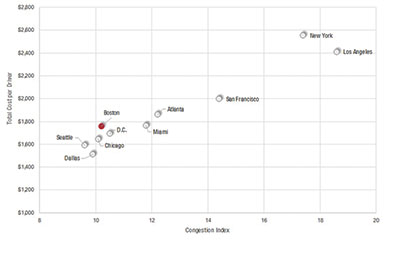
The graph below highlights the 10-most congested markets in the U.S.; comparing total cost per driver against INRIX’s congestion index. New York and Los Angeles outpace the rest of the pack by a wide margin.
Not only does Boston land on INRIX’s top 10 list, but the city is also home to one of the most congested corridors in the U.S. According to the report, I-93 Northbound (from exit 5A/MA-24 to Exit 16) ranked 4th among the 10-worst corridors in the country. The morning commute appears to be the most congested. Northbound average morning speeds were only 27.7 mph while evening speeds were 43.5 mph. Total hours of delay per year reached 72 hours on this stretch highway.
While a sign of positive economic growth, the cost of congestion in Boston remains a risk worth keeping an eye on.
Liz Berthelette is director of research at NAI Hunneman, Boston, Mass.
MORE FROM Owners Developers & Managers
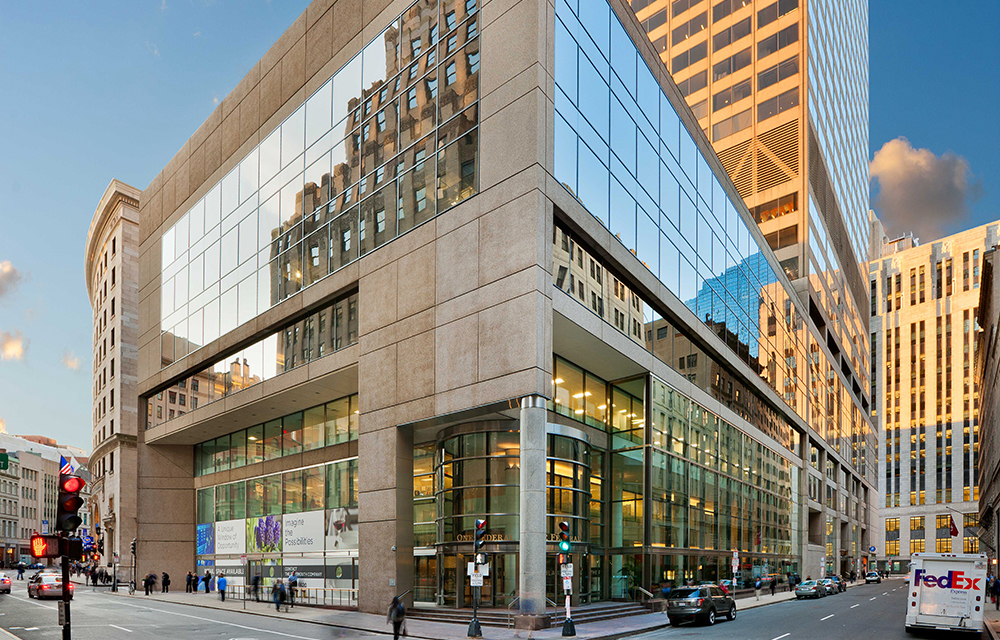
Rubin Rudman to establish headquarters at Tishman Speyer’s One Federal St.
Boston, MA Tishman Speyer has secured a new headquarters lease with Rubin Rudman at One Federal St., its 38-story, 1.1 million s/f tower in the Financial District. Under a 15-year lease, Rubin Rudman’s new headquarters will span 57,844 s/f across One Federal’s entire 23rd and 24th floors and a portion of the 25th floor.





Quick Hits
 (1).png)

Columns and Thought Leadership

IREM president’s message: Our new reality - Staying ahead of supply chain delays - by Yoany Vargas
Supply chain delays are slowing construction, ratcheting up operating costs, and extending turnover timelines across Greater Boston, directly reducing revenue and increasing the workload for multifamily and

Revitalized Town Centers: Retail??? - by Carol Todreas
It is now widely accepted that customers want to shop in person at physical stores. Brands know that they do better business in a physical store than just on line so they want to open stores. Demand for retail space by digital merchants, local entrepreneurs, and newly developed national chains

The legislature has spoken: New Hampshire doubles down on housing in commercial zones - by John Sokul
Last year, the New Hampshire Legislature enacted HB 631, a landmark housing measure requiring municipalities to permit multifamily housing in commercially zoned districts. The law generated

Retail infill strategy to activate Pawtucket’s Conant Thread District - by Gaetan Kashala
Until recently, the Conant Thread District consisted of approximately 150 acres of underutilized industrial land spanning Pawtucket and Central Falls. Today, the area is one of the most significant