



News:
Spotlight Content
Posted: March 28, 2025
Ask the electrician: How do modern LEDs streamline maintenance and improve cleanliness? - Brian Leborgne

In the realm of building maintenance, advancements in LED technology are proving to be transformative, extending far beyond simple illumination. In this Ask the Electrician column, we’ll discuss how LED fixtures streamline building maintenance and even enhance indoor air quality, exploring innovations that range from simplified circuitry and maintenance-free operation to groundbreaking air purification capabilities.
The compact nature and reduced power consumption of today’s LEDs significantly simplify maintenance. For example, we can now install multiple LED lights on a single circuit, a feat previously unattainable with fluorescent or incandescent lighting. This translates to fewer circuits, less equipment, and ultimately, reduced maintenance time and resources.
Building on the benefits of simplified circuitry, some LED fixtures take maintenance reduction even further with maintenance-free operation, eliminating the need for room entry. This is particularly beneficial in “clean rooms” and healthcare settings. These fixtures are installed in compartments above the ceiling, allowing service crews to perform maintenance from above, minimizing the risk of room contamination.
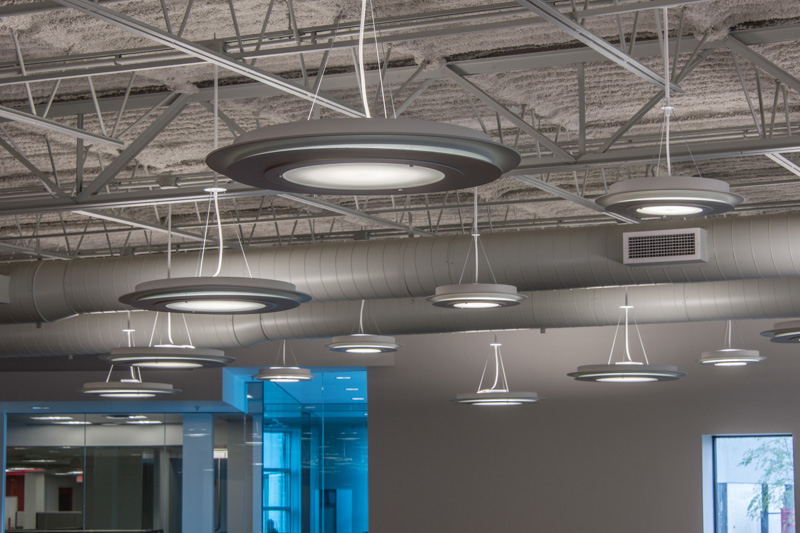
Beyond simply reducing maintenance, LED technology is also improving air quality. Moreover, innovative LED technologies, such as Visible Light Disinfection or Continuous Environmental Disinfection Systems, have revolutionized air quality. These lights emit narrow-spectrum light that effectively kills bacteria and infections like staph and MRSA, while also providing light. There are also motion-sensing lights that seamlessly transition from standard lighting to sterilization mode when a room remains unoccupied for a predetermined duration.
In contrast, traditional fluorescent and older LED fixtures often required the removal of lenses and screws for maintenance, necessitating room shutdowns, cleaning, and sterilization. Indigo-Clean technology, however, provides continuous air purification, minimizing the need for frequent room cleaning and sterilization cycles.
Additionally, robust and vandal-resistant LED fixtures are now available, offering significant cost savings and reduced maintenance burdens. These fixtures, engineered with durable materials and anti-tampering features, are ideal for high-traffic areas such as gyms, parking garages, schools, and public buildings.
In essence, the evolution of LED technology has reshaped the landscape of building maintenance, offering a multifaceted approach that extends beyond mere illumination. From the streamlined efficiency of simplified circuitry and maintenance-free operation, to the groundbreaking air purification capabilities of specialized LEDs, these advancements are driving significant cost reductions, improved safety, and enhanced indoor environments. By embracing these innovations, building managers can achieve a more sustainable, efficient, and healthy future for their facilities.
Brian Leborgne is a regional manager - service with Interstate Electrical Services Corp., North Billerica, Mass.
Tags:
Spotlight Content
MORE FROM Spotlight Content

New England Real Estate Journal's 2026 Women in Commercial Real Estate Spotlight
NEREJ's Women in CRE Spotlight celebrates the women making an impact across commercial real estate and the companies that recognize, support and champion them.







Quick Hits

Columns and Thought Leadership

How do we manage our businesses in a climate of uncertainty? - by David O'Sullivan
These are uncertain times for the home building industry. We have the threat of tariffs mixed with high interest rates and lenders nervous about the market. Every professional, whether builder, broker, or architect, asks themselves, how do we manage our business in today’s climate? We all strive not just to succeed, but

Limited supply fuels landlord‑friendly conditions in Rhode Island’s industrial market - by Julie Freshman and George Paskalis
As we enter the spring of 2026, the Rhode Island industrial real estate market stands on stable footing, following several years of resilience fueled by constrained supply, steady demand, and dynamic economic conditions.

Shallow-bay wins on 495/128: A renewal-driven market with a thin pipeline - by Nate Nickerson
The Boston industrial market entered mid-2025 in a bifurcated state. Large-block vacancy remains elevated, while shallow-bay along the 495/128 corridor continues to prove resilient. Fieldstone’s focus on this geography positions us squarely in the middle of a renewal-driven, supply-constrained

As legacy names recalibrate, new entrants are moving in with fresh capital, new technologies, and business models tailored to today’s supply-chain needs - by Michael Harrington
Southern New Hampshire’s industrial market has always punched above its weight. For decades, the region has attracted a mix of advanced manufacturing, beverage and food producers, logistics operators, and specialty
