


 (1).png)
News:
Owners Developers & Managers
Posted: February 6, 2014
Beacon Communities LLC sells Baker Chocolate Factory to Fairfield Residential for $24 million
CBRE/New England's capital markets team completed the sale of Baker Chocolate Factory Apartments, a 133-unit, urban infill apartment community. BC Adams Street LLC, an affiliate of Beacon Communities LLC, sold the asset to FF Realty II, LLC, an affiliate of Fairfield Residential, for $24,131,900.
CBRE/NE's multi-housing experts Simon Butler, executive vice president/partner, and Biria St. John, executive vice president/partner, exclusively represented the seller and procured the buyer.
"We are pleased to have facilitated this transaction on behalf of the seller," said CBRE/NE's St. John. "Baker Chocolate Factory represents a truly one-of-a-kind mill conversion that underwent significant upgrades under Beacon's watch and is now benefiting from the recent rise in rents in the urban areas."
Baker Chocolate Factory Apartments consists of three attached historic renovated mill buildings that were originally built in the late 1800s to serve as the headquarters for the Baker Chocolate Company. The buildings were then converted to residential use between 1982 and 1985. In 2008, Beacon acquired the buildings and undertook a major capital campaign, renovating unit interiors, together with common area upgrades and a conversion from oil to gas heat and hot water. Community amenities include elevator access, a fitness center with cardio and strength training equipment, beautiful courtyards and picnic area along the Neponset River.
The unit mix is comprised of 12 (9%) studios, 80 (60%) one-bedroom apartments and 41 (31%) two-bedroom apartments with an average overall unit size of 792 s/f. Many of the units feature exposed brick walls with oversized windows, 9-12' ceiling heights, and views of the Neponset River.
MORE FROM Owners Developers & Managers
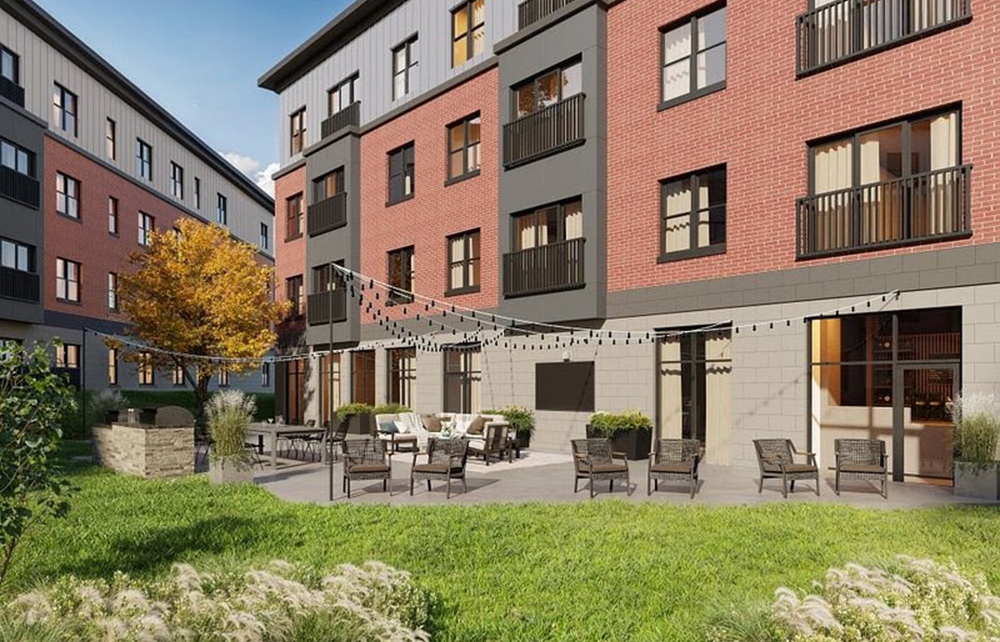
Cathartes and Tidemark set to open first phase of Marlo on Mill Pond
Portsmouth, NH According to Cathartes and Tidemark, the first of new luxury waterfront apartment homes will become available this fall in the city’s West End. Located at 75, 85 and 95 Addorio Way, Marlo on Mill Pond will feature 151 studio,




Quick Hits


Columns and Thought Leadership

Revitalized Town Centers: Retail??? - by Carol Todreas
It is now widely accepted that customers want to shop in person at physical stores. Brands know that they do better business in a physical store than just on line so they want to open stores. Demand for retail space by digital merchants, local entrepreneurs, and newly developed national chains

Retail infill strategy to activate Pawtucket’s Conant Thread District - by Gaetan Kashala
Until recently, the Conant Thread District consisted of approximately 150 acres of underutilized industrial land spanning Pawtucket and Central Falls. Today, the area is one of the most significant

IREM president’s message: Our new reality - Staying ahead of supply chain delays - by Yoany Vargas
Supply chain delays are slowing construction, ratcheting up operating costs, and extending turnover timelines across Greater Boston, directly reducing revenue and increasing the workload for multifamily and

The legislature has spoken: New Hampshire doubles down on housing in commercial zones - by John Sokul
Last year, the New Hampshire Legislature enacted HB 631, a landmark housing measure requiring municipalities to permit multifamily housing in commercially zoned districts. The law generated