


 (1).png)
News:
Owners Developers & Managers
Posted: June 2, 2017
Budget considerations and your parking lot - by Mike Musto

Services, Inc.
Budgets are not just about money. Budgets can be about timing too. For your parking lot needs, spring is an ideal time to evaluate the condition of your properties. But let’s face it, budgets are challenging no matter what time of year it is. As a property manager entrusted with the responsibility of managing and maintaining costs, the task of staying on budget while addressing essential needs and services is a daily or even hourly challenge. A well-considered budget has contingencies for emergencies and other unforeseen occurrences along with fixed costs to account for. But what about the costs associated with money not spent due to budget constraints, management mandates or the seemingly not urgent enough nature of a given issue? If you’ve ever ignored that “check engine” light for days or months only to get stranded somewhere and forced to pay for towing on top of repairs, you know the pain of final costs multiplied due to inaction. That same principle can be applied to your pavement and concrete.
Effective preventive measures taken to protect and preserve your asphalt surfaces will ultimately save money in the long run. Beyond that it’s proactive property management and smart budgeting. Ignoring your asphalt surface issues because they are “not in the budget this year” or “not really that bad” is the equivalent of ignoring that engine light on your dashboard. Eventually you will have to address the problem and like an unmaintained car, an unmaintained lot just won’t work for you or your tenants and customers. 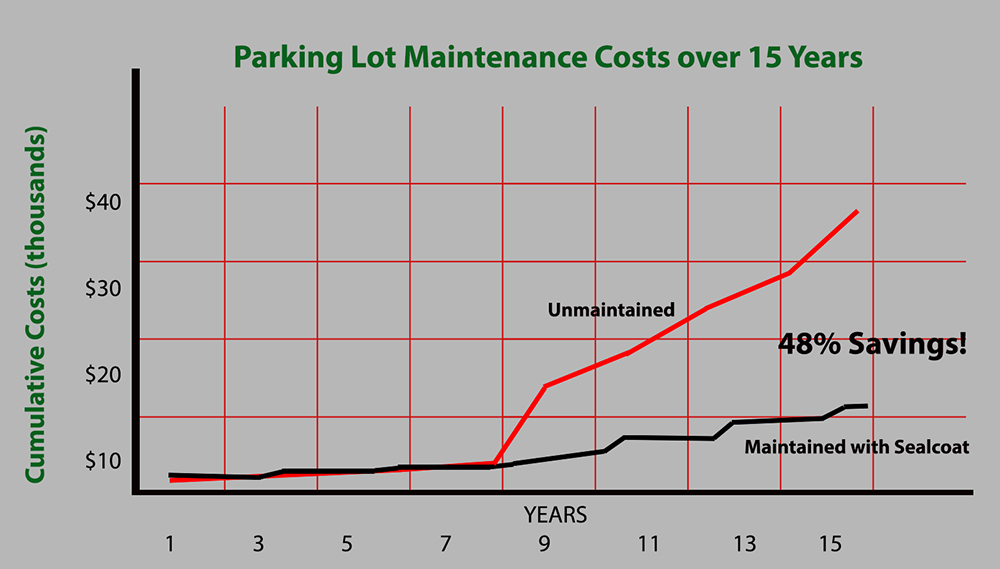
A great example of an affordable asphalt maintenance program that not only preserves, protects and beautifies your property but also defers more costly repairs down the road is sealcoating. An independent study conducted by the University of Nevada at Reno found that sealcoating your asphalt surfaces every 3 years saves property owners an average of over $15 per square yard as compared to unmaintained surfaces. That’s a nearly 50% savings over the course of 15 years or as much as $150,000 for an average property. The alternative is unsafe parking lot conditions with trip hazards like potholes, cracks and drainage problems, which expose property owners to dangerous and costly liabilities. A comprehensive maintenance program that includes regular sealcoating, crackfilling, pothole and drainage repair not only is an essential part of maintaining your property but also a significant cost controller over time.
The evaluation process, which identifies the true nature and severity of your parking lot issues, is the essential first step and dictates the success (or potential failure) of your overall project. Capital expenditures are at stake and an inadequate evaluation at the start could mean tens of thousands of dollars in corrective repairs, not to mention the damage to your business and professional reputation. Enlisting a single scope contractor to evaluate your lot needs invariably leads to single scope solutions which serve the contractor’s best interest and not yours. Partnering with a professional that not only has mastered the primary disciplines of asphalt, concrete and asphalt maintenance (patching, sealcoating, crackfilling, infrared repairs, drainage repair and line striping) is required to ensure the best results.
Long term, a trusted partner with multi-discipline asphalt experience as well as an understanding of your particular needs on site serves as the solid foundation of a successful contractor relationship. That is true for every service vendor you work with. Standards are standards because they don’t change according to circumstance, convenience or yes, even the mighty budget. A contractor who knows your people, your process, your brand and your needs on an intimate level saves time and money. That’s a true pavement partner.
Mike Musto is the founder and CEO of U.S. Pavement Services, Inc., Woburn, Mass.
MORE FROM Owners Developers & Managers
The Lodge at Spruce Peak recognized with Condé Nast Traveler’s 2026 Readers’ Choice Award - #3 in New England
Stowe, VT Condé Nast Traveler revealed the results of its annual Readers’ Choice Awards, with The Lodge at Spruce Peak recognized as the #3 U.S. Resort in New England.







Columns and Thought Leadership

IREM president’s message: Our new reality - Staying ahead of supply chain delays - by Yoany Vargas
Supply chain delays are slowing construction, ratcheting up operating costs, and extending turnover timelines across Greater Boston, directly reducing revenue and increasing the workload for multifamily and

Revitalized Town Centers: Retail??? - by Carol Todreas
It is now widely accepted that customers want to shop in person at physical stores. Brands know that they do better business in a physical store than just on line so they want to open stores. Demand for retail space by digital merchants, local entrepreneurs, and newly developed national chains

Retail infill strategy to activate Pawtucket’s Conant Thread District - by Gaetan Kashala
Until recently, the Conant Thread District consisted of approximately 150 acres of underutilized industrial land spanning Pawtucket and Central Falls. Today, the area is one of the most significant

The legislature has spoken: New Hampshire doubles down on housing in commercial zones - by John Sokul
Last year, the New Hampshire Legislature enacted HB 631, a landmark housing measure requiring municipalities to permit multifamily housing in commercially zoned districts. The law generated