


 (1).gif)
News:
Finance
Posted: July 9, 2021
Construction costs spike, but hope is on the way - by Daniel Calano

Have you been reading up on the cost of construction materials through the roof? How could you miss it!
For example, two by fours, the bedrock of house construction, has gone from around $3 per 8’ board to $8 per board, about 200 to 300% increase. Steel and copper increases have been less, but not by much. On the anecdotal side, an architect friend told me that three of his shovel-ready jobs were canceled due to construction costs. The owners were anxious to get going, until they saw the house price, which was an unbelievable 300% increase. As a hedge, about half of the builders indicate they are adding “escalation clauses” to their sales price because of rising costs, according to the National Association of Home Builders.
The facts are that new construction has gone from red-hot to tepid. Single-family housing starts dropped 13% this past April compared with March. (U.S. Census) That is the sharpest net decrease since last April, when the pandemic shutdown started. The 1,160 sales that occurred this May was the lowest for this month since 2015. Single family sales are still at high levels, but significantly below what they were a few months ago. The same is true for sale/construction of some office buildings which have been put on hold. How did this all happen?
The first factor was the lock down for most construction over a year ago with the start of COVID. This condition alone forced delays and caused workers to seek other work, or even retire. When construction started up again, labor was hard to find, but home buying was full on, as young people wanted to escape cities. The lag in construction, paired with increased demand, had builders playing catch up. Even with lumber production at a 10-year high, supply was not adequate to meet demand. No economics degree needed to understand that short supply and high demand cause high prices.
A second issue was more political, caused by tariffs and tensions arising in China, as well as Canada. Between those political concerns, as well as transportation problems also due to COVID, it was a perfect storm for a troublesome supply chain. It was not just home construction materials, but everything from furniture to appliances had been impacted by the supply chain. The wait time for most everything is at least several months.
It was difficult to ignore the inflationary factors in the marketplace. Prices were rising, but the markets were being flooded with cheap money, soothing some of the pain. But, chairman Powell of the Federal Reserve Bank suggested that home and other building construction inflation was temporary and would subside as supply chain improved. Many doubted this, but he has been correct.
Some help is on the way. As chairman Powell said, some costs have started to come down…not back to normal levels, by any means, but perhaps by 20 to 30%. It is also possible that the Fed will move faster on “tightening,” thereby reducing money supply, and lowering some demand. This may cause people to feel that the houses they have are adequate, that business buildings don’t need to be utilized as heavily, etc.
Will it be back to normal with prices just like pre-COVID times? In my opinion, not a chance. Inflation issues like this are not completely elastic. While price of materials and goods will come down, it is unlikely they will return to the past. Inflated prices can be sticky, as people get used to them. Probably no one will build at a 300% cost increase, but many will accept 25% as just a fact of life.
Daniel Calano, CRE, is managing partner and principal of Prospectus, LLC, Cambridge, MA.
MORE FROM Finance
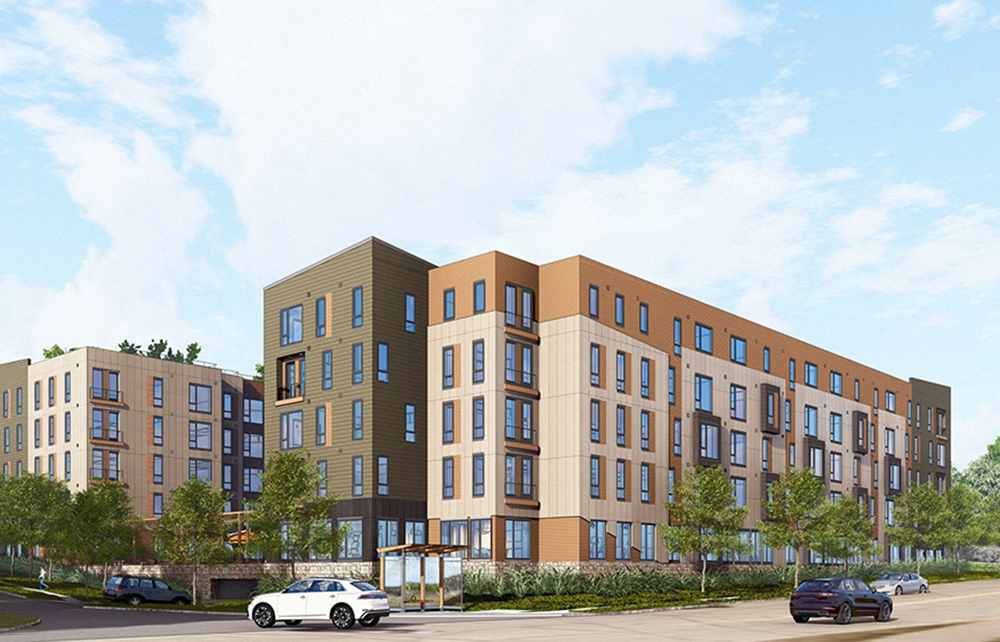
Affinius Capital and Axonic Capital provide $45.8 million construction loan for 130-unit multifamily
Lexington, MA Affinius Capital LLC (Affinius Capital), in partnership with Axonic Capital LLC (Axonic), originated a $45.8 million loan to finance the ground-up development of 7 Hartwell Ave., a to-be-built, 130-unit, Class A multifamily property with 400 s/f of retail.




 (1).gif)


Quick Hits

Columns and Thought Leadership

Are appraisers on the same page as the assessor? - by Richard Seman
The purpose of this article is to address problematic or confusing issues which may help assessors and appraisers to better understand how to value real estate for tax assessment purposes.

Reverse exchanges and the challenges of a competitive real estate market - by Michele Fitzpatrick
Our current, highly competitive real estate market poses specific challenges for investors who are considering taking advantage of a tax-deferred 1031 exchange. In this market, investors will have no problem selling their current property if priced properly, but they may find it difficult to find a suitable replacement property

Massachusetts real estate transfers over $1 million face new tax rules as of November 1st - by Daniel Meyer
Attention to owners of real estate in the Commonwealth (and the title companies and other professionals who advise them), the Massachusetts Department of Revenue (the “DOR”) recently adopted a new “millionaire’s tax” via 830 CMR 62B.2.4

The focus on price per s/f compared to the comparable sales used in the appraisal report - by Dennis Chanski
Over the past several weeks, I have completed appraisal assignments for private clients. Interestingly, after submitting these appraisals, I received several phone calls – not to question the value, content, or any incorrect information, but rather to discuss the price per s/f compared to the comparable sales used in the report.
