

 (1).png)

The caliber of a community’s educational infrastructure is one of the most powerful indicators of its long-term economic outlook. Modern, well-maintained schools do more than educate students, they define and anchor neighborhoods, attract employers and individuals, and strengthen the quality of life. As an economic development organization, The Pawtucket Foundation believes that the business community has an essential role to play in advancing student achievement and learning outcomes. The Foundation’s approach is captured in our Six Ships Framework focused on leadership, scholarship, mentorship, apprenticeship, entrepreneurship, and sponsorship (Blessed be the Funders.) Together, these elements inform our perspective around how businesses can support investments in human capital development and its consequent community prosperity.
The Rhode Island Health and Educational Building Corp. (RIHEBC) has been a vital partner in Pawtucket’s educational reimagination. Established by the General Assembly in 1966, RIHEBC provides financing for educational and health institutions throughout the state. Legislative updates in 2003 and 2016 expanded its mandate to issue bonds for municipal school projects and to administer the School Building Authority Capital Fund, which supports local districts with loans and grants for facility improvements. Since fiscal year 2016, RIHEBC has provided more than $2.5 billion in financing for school projects statewide. These investments have created more than 4,000 jobs and generated an estimated $4 billion in economic activity in Rhode Island. Pawtucket has been one of the greatest beneficiaries, using these funds to transform its public education infrastructure and catalyze local economic activity.
The Minneapolis Federal Reserve defines business climate as “the perceived hospitality of a state or locality to the needs and desires of businesses located in or considering a move to that jurisdiction.” It identifies five key components: education, physical infrastructure, regulation, taxation, and modernization. RIHEBC’s work directly supports Pawtucket’s business climate by financing projects that strengthen both human and social capital and the academic built environment. Quality schools not only produce a more skilled and adaptable workforce but also signal long-term community stability, an essential factor for businesses and individuals considering investment or relocation. 21st century learning environments also hold the promise of closing the achievement gap between socioeconomically advantaged and disadvantaged students.
In 2013, Pawtucket adopted a School Facilities Master Plan that highlighted the urgent need for modernization. Many of the city’s school buildings were approaching 100 years old, suffering from poor environmental conditions, structural deficiencies, outdated systems, and inadequate health and safety features. Recognizing this, mayor Grebien’s administration, the city council, and the school committee committed to a comprehensive investment strategy with RIHEBC at its core. Even more importantly, Pawtucket’s voters have time and again shown their commitment to quality schools by supporting the bond questions that provide the critical funding necessary to invest in our city’s future.
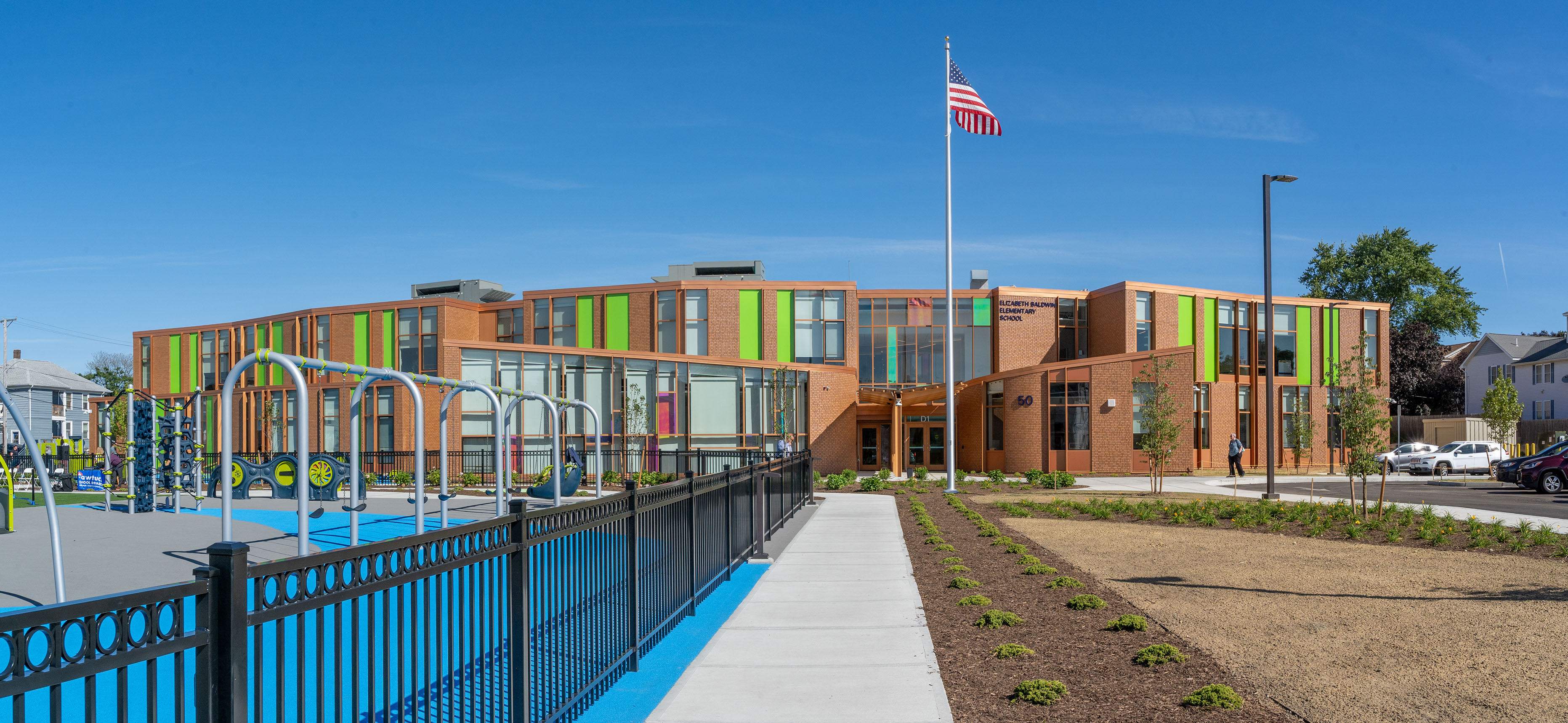
Through RIHEBC financing, Pawtucket is now delivering on a number of transformative school projects that are compliant with RI’s Department of Education’s design standards for educational programming and Northeast Collaborative for High Performing Schools. Shawmut Design and Construction, Colliers Project Leaders, and Jonathan Levi Architects have spearheaded the construction of a new unified high school at the former site of McCoy Stadium, the largest school construction project in Rhode Island’s history (~$330 million). The new Winters Elementary School and Baldwin Elementary School have been designed for 21st century learning. Nathaniel Greene Elementary School underwent renovations in 2017 and 2018 positioning it as a “like new” facility upon completion, and Potter Burns Elementary School was similarly fully renovated. Additionally, the purchase and retrofit of St. Leo’s Parish on Central Ave. has served as a temporary space for students during construction phases. Since 2017, RIHEBC has provided $178 million in bond financing for Pawtucket’s school projects, with more to come. These initiatives have been supported by state leadership including governor Dan McKee, speaker Joe Shekarchi, senate president Val Lawson, and treasurer James Diossa, who all recognize that educational investment drives economic growth and competitiveness.
The impact of RIHEBC’s financing extends far beyond the classroom. The direct, indirect, and induced impacts of these expenditures have fueled growth in construction, finance, and professional services, while boosting local household earnings, tax revenues, and overall GDP. From a real estate perspective, modern educational facilities stabilize neighborhoods, increase property values, and attract both residential and commercial investment. High-quality schools signal confidence in a city’s future helping employers recruit talent, encouraging developers to invest, and reassuring residents that Pawtucket is on an upward trajectory. Since 2012, Pawtucket’s voters have approved $611 million in bonds financing for school construction projects across the city reflecting strong public support. Importantly, schools in Pawtucket also serve as community anchors hosting elections, emergency shelters, civic meetings, and community programming, rendering their rehabilitation a broader act of social and civic renewal.
Pawtucket is at a pivotal moment in its educational transformation. Investments in educational infrastructure complement broader efforts in downtown redevelopment, business attraction, riverfront activation, workforce development, and housing expansion. This strategic vision and accompanying initiatives will position Pawtucket as an economic, academic, and cultural center of influence in Rhode Island. Pawtucket’s reimagination can be instructive to communities across New England: education is not just a social investment, it’s also economic infrastructure. When schools thrive, neighborhoods strengthen, businesses grow, and cities flourish. RIHEBC’s motto is “Building Rhode Island Future” and that’s precisely what we are witnessing in Pawtucket thanks to its productive partnership with the city of Pawtucket.
Dylan Zelazo is the executive director of the Rhode Island Health and Educational Building Corp., Providence, and Gaetan Kashala is the executive director of the Pawtucket Foundation, Pawtucket, R.I.




 (1).png)



Supply chain delays are slowing construction, ratcheting up operating costs, and extending turnover timelines across Greater Boston, directly reducing revenue and increasing the workload for multifamily and