



News:
Spotlight Content
Posted: January 27, 2023
KW Elite Commercial Realty commercial market report for 2023 - by Mike Alves

Following a pandemic-fueled course correction, the global real estate industry faces transformational shifts in how buildings will be used, valued, and transacted in 2023 and beyond.
The 2023 commercial real estate outlook indicates there may be challenges ahead. Retail is at a crossroads, and the future of office space is unclear. Plus, supply chain issues persist, and inflation is near 40-year highs, prompting the Fed to steadily increase interest rates. But there are a few bright spots in the commercial real estate forecast. Multifamily properties continue to perform well, and the hot streak for industrial properties remains. Multifamily is currently the highest performing of all asset classes. “As of the third quarter of 2022, multifamily vacancies are at 4.4%—a five-year low,” said Victor Calanog, head of commercial real estate Economics at Moody’s Analytics.
The retail property forecast largely depends on location and retail category. For example, people still want to shop at a grocery store for certain items, pick up prescriptions, get a haircut or grab coffee. Neighborhood shopping centers in well-populated residential areas continue to perform well.
This is causing a rebirth and development of B and C class retail centers. Also the insurgence of city grants and funds to small business are increasing the interest of startup businesses and increasing the smaller space retail of 800 s/f to 1,500 s/f to lease for high lease rates. Also making these spaces rare to find decreasing vacancy rates.
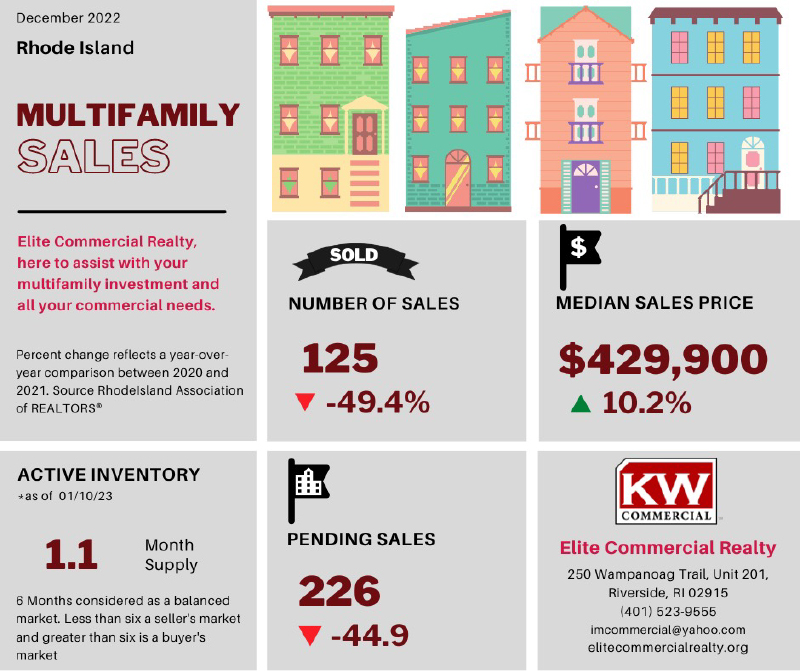
Sales activity tumbled most in the multifamily home market, dropping 49.4% compared to 12 months prior. The median price of multifamily home sales in December saw the highest gains of all housing types, however. The price of $429,900 represented a 10.2% gain from the $390,000 median price realized in December 2021. Pending sales fell by 44.9% year-over-year and the average days on the market climbed by 9.7%, another indication of slowing activity in the months ahead.
Multifamily owners and investors aren’t immune to cost increases. But they can adjust rents annually—sometimes even monthly—to account for market changes. Multifamily properties will remain with strong rents thru 2023, but the purchase cap rate will have to increase for buyers due to higher interest rates, taxes and expenses. In 2023 the multi- family will still be the best income purchase for investors.
Some investors took equity line and cashed out by selling their properties and took the tax hit in anticipation of buying multi’s at a much higher cap in 2023. The correction has started. We should see a full impact by 3Q 2023.
Industrial outlook for 2023 appears to be strong for warehouse storage, tech, and R&D. There is a shortage of spaces in the 10,000 s/f to 50,000 s/f spaces. This will continue to be a hot commodity in 2023.
As we head into the new year, keep an eye on these 2023 commercial real estate trends and opportunities.
Mike Alves is the president/broker owner of KW Elite Commercial Realty, Riverside, R.I.
Tags:
Spotlight Content
MORE FROM Spotlight Content

New England Real Estate Journal's 2026 Women in Commercial Real Estate Spotlight
NEREJ's Women in CRE Spotlight celebrates the women making an impact across commercial real estate and the companies that recognize, support and champion them.








.png)
Columns and Thought Leadership

As legacy names recalibrate, new entrants are moving in with fresh capital, new technologies, and business models tailored to today’s supply-chain needs - by Michael Harrington
Southern New Hampshire’s industrial market has always punched above its weight. For decades, the region has attracted a mix of advanced manufacturing, beverage and food producers, logistics operators, and specialty

How do we manage our businesses in a climate of uncertainty? - by David O'Sullivan
These are uncertain times for the home building industry. We have the threat of tariffs mixed with high interest rates and lenders nervous about the market. Every professional, whether builder, broker, or architect, asks themselves, how do we manage our business in today’s climate? We all strive not just to succeed, but

Shallow-bay wins on 495/128: A renewal-driven market with a thin pipeline - by Nate Nickerson
The Boston industrial market entered mid-2025 in a bifurcated state. Large-block vacancy remains elevated, while shallow-bay along the 495/128 corridor continues to prove resilient. Fieldstone’s focus on this geography positions us squarely in the middle of a renewal-driven, supply-constrained

Limited supply fuels landlord‑friendly conditions in Rhode Island’s industrial market - by Julie Freshman and George Paskalis
As we enter the spring of 2026, the Rhode Island industrial real estate market stands on stable footing, following several years of resilience fueled by constrained supply, steady demand, and dynamic economic conditions.
