


 (1).gif)
News:
Finance
Posted: September 10, 2015
Liquidity is a good defense and offense in volatile markets
Turmoil, downturn or collapse...just some more jiggles, bigger than before. As China moves to restore its economy, the global trading community prepares to participate in the new global order. Our FED prepares to increase rates in an orderly manner, respecting the data on the domestic economy, including the ripples from the China troubles. Commercial real estate is dependent on job gains and a stable, growing economy. Trailing fundamentals stateside are persistently positive. Anecdotal indications of marginal economic erosion from global woes will make the FED decision and data analyses more complicated than anticipated just days ago before the market turmoil. Everyone is sitting at this table and the volatility is painful.
The FED meets on September 15-16 to discuss the data and the rates. Boston FED president Eric Rosengren, a nonvoting member of the Federal Open Markets Committee, assured us that the FED action will be gradual in an interview with the Boston Globe on September 1. Rosengren said policy makers are watching the movement and impact of the global stock markets to determine whether the recent turmoil signals a long-term downturn or a temporary slip as investors to changing economic conditions. Rosengren told the Forecasters Club of New York that (We) don't have a great explanation of why the stock markets are down around the world and it makes Rosengren want to gather more information. On September 2, Boston Globe staffers Megan Woodhouse and Beth Healy respectively covered Rosengren/FED and China/FED including the wide ranging complexities of the turmoil's and impacts on the domestic economy. Uncertainty dominated the macroeconomic commentary in the Boston Globe, and most commentators were at a pause. Domestic commercial real estate markets will be impacted in some way depending on micro market conditions.
Investment advisors are generally holding tight; some are selling and some are buying and some are losing. To reduce the risk of exposure to the market volatility, California State Teachers' Retirement System, CALSTRS, is considering shifting $20 billion away from stocks and bonds, a risk mitigation strategy. The CALSTRS board will consider this substantial reduction in allocation at year end meeting and will also be analyzing ongoing increases in beneficiary payouts. Commercial real estate allocation is not expected to decrease or increase in CALSTRS in risk mitigation strategy. David Mazza, head of exchange traded fund (ETF) research at State Street Global Advisors, said ETF's have represented 40% of trading volume in recent days. All data points contribute to a better understanding of what will be next.
Liquidity is a good defense and offense in volatile markets. The European Central Bank (ECB) will be considering further quantitative easing at the next ECB meeting. Be nimble, be alert. Stay engaged. Fed will act on rates soon and the action will be based on sustainable economy.
David Kirk, CRE, MAI, FRICS, is principal and founder of Kirk & Company, Real Estate Counselors, Boston.
MORE FROM Finance
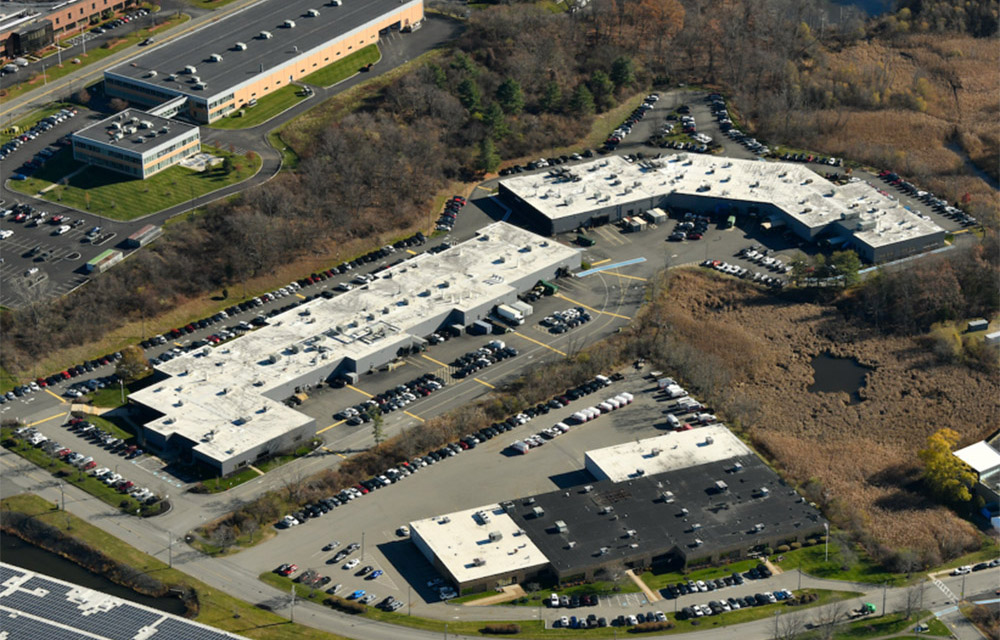
Northwest Bank finances Luzern Associates’ $47.75m acquisition
Danvers, MA Northwest Bank provided $34.5 million in financing to support Luzern Associates LLC’s $47.75 million acquisition of the Cherry Hill industrial portfolio, a three-building campus totaling 200,000 s/f.




 (1).gif)


Quick Hits


Columns and Thought Leadership

Reverse exchanges and the challenges of a competitive real estate market - by Michele Fitzpatrick
Our current, highly competitive real estate market poses specific challenges for investors who are considering taking advantage of a tax-deferred 1031 exchange. In this market, investors will have no problem selling their current property if priced properly, but they may find it difficult to find a suitable replacement property

Massachusetts real estate transfers over $1 million face new tax rules as of November 1st - by Daniel Meyer
Attention to owners of real estate in the Commonwealth (and the title companies and other professionals who advise them), the Massachusetts Department of Revenue (the “DOR”) recently adopted a new “millionaire’s tax” via 830 CMR 62B.2.4

The focus on price per s/f compared to the comparable sales used in the appraisal report - by Dennis Chanski
Over the past several weeks, I have completed appraisal assignments for private clients. Interestingly, after submitting these appraisals, I received several phone calls – not to question the value, content, or any incorrect information, but rather to discuss the price per s/f compared to the comparable sales used in the report.

Are appraisers on the same page as the assessor? - by Richard Seman
The purpose of this article is to address problematic or confusing issues which may help assessors and appraisers to better understand how to value real estate for tax assessment purposes.
