


 (1).gif)
News:
Finance
Posted: September 8, 2011
Love Funding closes $60.6 million construction financing for Bainbridge Bethesda
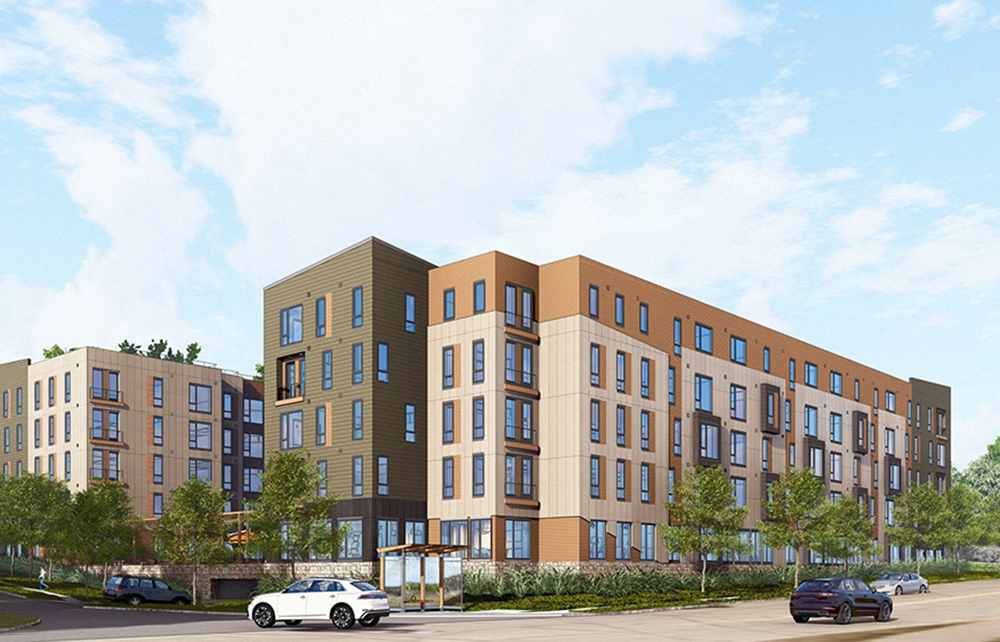
Love Funding has closed a $60.6 million loan for the construction of Bainbridge Bethesda, a 200-unit apartment building.
Holly Bray, a first vice president at Love Funding in Washington D.C., secured the loan through the Federal Housing Administration's 221(d)(4) loan program. The property's inclusion of 30 moderately priced units helped it win HUD support, as did its pending LEED Silver certification and its proximity to public transportation hubs, schools and a thriving business district.
The transaction closed at a time when several marquee apartment projects in Bethesda remain stalled due to difficulty securing financing. Demand for HUD's multifamily loan insurance has jumped as private lenders remain on the sidelines; the agency closed nearly $14 billion in multifamily housing loans in fiscal 2010, up from just $5.4 billion the year before.
"HUD is still being very selective when it comes to approving deals of this magnitude, and Bainbridge effectively demonstrated that this building will be in a class of its own," Bray said.
The Bainbridge Bethesda transaction capped off a record-breaking month for Love Funding in July, when the company closed on 11 loans totaling $216 million.
Love Funding is one of the Love Companies, a St. Louis-based investment holding company with origins dating back to 1875. Love Funding commenced mortgage-banking operations in 1984 and serves clients across the United States from its offices in Boston, Cleveland, Dallas, Denver, Detroit, Kansas City, Knoxville, New York, Palm Beach, St. Louis and Washington D.C. The company offers refinance, construction and acquisition financing programs for multifamily, senior housing and healthcare facilities. Love Funding is a fully-approved HUD LEAN and MAP lender.
Tags:
Finance
MORE FROM Finance
Affinius Capital and Axonic Capital provide $45.8 million construction loan for 130-unit multifamily
Lexington, MA Affinius Capital LLC (Affinius Capital), in partnership with Axonic Capital LLC (Axonic), originated a $45.8 million loan to finance the ground-up development of 7 Hartwell Ave., a to-be-built, 130-unit, Class A multifamily property with 400 s/f of retail.




 (1).gif)




Columns and Thought Leadership

The focus on price per s/f compared to the comparable sales used in the appraisal report - by Dennis Chanski
Over the past several weeks, I have completed appraisal assignments for private clients. Interestingly, after submitting these appraisals, I received several phone calls – not to question the value, content, or any incorrect information, but rather to discuss the price per s/f compared to the comparable sales used in the report.

Reverse exchanges and the challenges of a competitive real estate market - by Michele Fitzpatrick
Our current, highly competitive real estate market poses specific challenges for investors who are considering taking advantage of a tax-deferred 1031 exchange. In this market, investors will have no problem selling their current property if priced properly, but they may find it difficult to find a suitable replacement property

Are appraisers on the same page as the assessor? - by Richard Seman
The purpose of this article is to address problematic or confusing issues which may help assessors and appraisers to better understand how to value real estate for tax assessment purposes.

Massachusetts real estate transfers over $1 million face new tax rules as of November 1st - by Daniel Meyer
Attention to owners of real estate in the Commonwealth (and the title companies and other professionals who advise them), the Massachusetts Department of Revenue (the “DOR”) recently adopted a new “millionaire’s tax” via 830 CMR 62B.2.4
