



News:
Construction Design & Engineering
Posted: November 19, 2008
Payette and Bowdoin complete science building at Gordon College
Payette and Bowdoin Construction have completed the Ken Olsen Science Center at Gordon College.
Named for Ken Olsen, the founder of Digital Equipment Corp. (DEC) and a member of the college's board of trustees, the new $21 million science center fosters interdisciplinary interaction and critical thinking.
The 83,154 s/f science building is a new facility that houses the departments of biology, chemistry, physics, computer science, mathematics, psychology, and movement science. It contains wet and dry labs, classrooms, faculty offices, a 400-seat auditorium, a case study/lecture hall and a main lobby.
Bowdoin Const. was selected by Gordon College to manage the construction of the science center in March of 2006.  Bowdoin, Gordon and Payette coordinated for four months prior to construction to address campus safety/logistics, phasing and constructability approaches. The project began in July of 2006 with the demolition of two buildings, including Byington Hall and the Wood Hall dormitory. Foundations for the new four-story science center were then cut into the side of the hill next to Coy Pond. Steel erection was substantially complete in late February of 2007 with a topping off ceremony. The beam was signed by Gordon students, school officials, and members of the design and construction team.   
The professional design team also included Vanderweil Engineers (mechanical and electrical engineers); R. W. Sullivan Engineering (plumbing and fire protection engineers, and code consultants); Simpson, Gumpertz and Heger (structural engineers); Moriece & Gary (civil engineers); and Acentech (acoustical consultants).  
MORE FROM Construction Design & Engineering
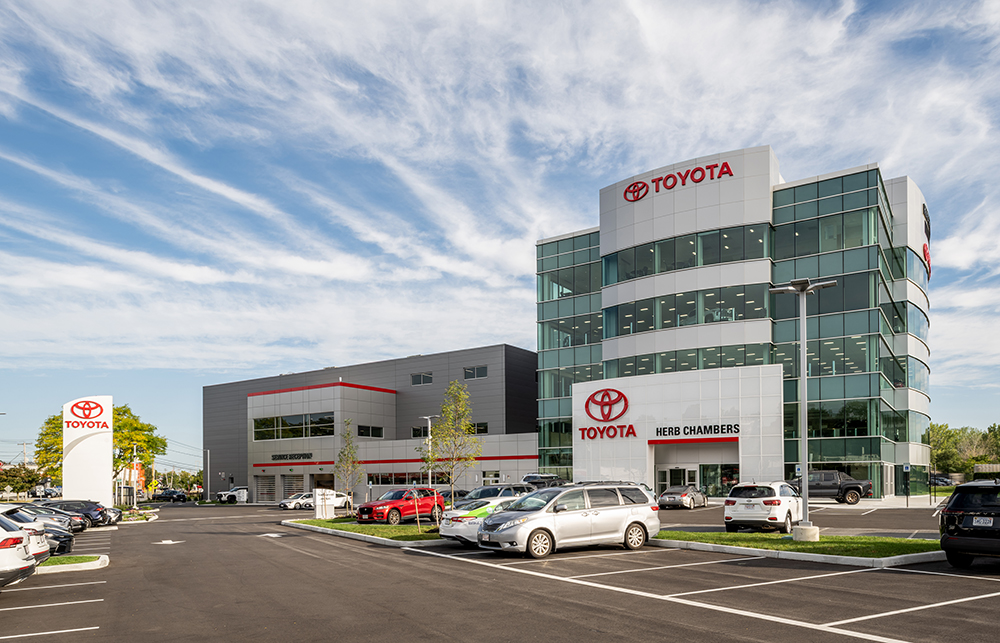
A CM&B project feature: Why dealers are looking beyond vacant land - The repositioning strategy behind Herb Chambers Toyota of Boston
Medford, MA When a five-story former bank headquarters along I-93 became one of Greater Boston’s largest Toyota dealerships, it signaled a broader shift in commercial real estate. It offered a glimpse into where the next generation of dealership growth may come from: opportunities hiding in plain sight within underutilized office and retail properties.






Columns and Thought Leadership

Greenwood Credit Union City Hall Plaza nears completion - by Frank Picozzi
After several years of planning, construction, and anticipation, the community is eagerly awaiting the opening of the Greenwood Credit Union City Hall Plaza and outdoor skating rink later this month.

ABC-Mass. chairman’s message: Rent control isn’t the answer to our housing crisis - by Luiza Mills
As you may know, Massachusetts voters will be weighing in on a number of ballot initiatives in November. Among them is a proposal to impose the nation’s strictest statewide rent control policy. I’d like to tell you why the ABC MA Board

Navigating tariffs and material uncertainty in today’s construction market - by Karl Ginand and Tiffany Gallo
As headlines around tariffs seem to dominate the news daily, many considering construction projects have anticipated major cost escalations and widespread supply issues. While tariffs haven’t driven pricing spikes to the extent once feared, the lasting impact has been a new layer of uncertainty, affecting more than just budgets.

Breathing easier: Elevating indoor air quality and performance in New England commercial spaces - by David Capra
cross the New England commercial real estate landscape, from urban life sciences hubs in Greater Boston to academic research facilities throughout the region, the metrics defining high-performing buildings are shifting. Tenants, developers, and facility owners are placing a renewed focus on an invisible yet vital asset: indoor air quality (IAQ).
