


 (1).png)
News:
Owners Developers & Managers
Posted: January 5, 2018
Question of the Month: Is there a better way to design a WiFi network besides putting in a cluster of WAPs & crossing your fingers? - by Jay Epstein

It’s nearly impossible for the modern professional to get a reprieve from receiving or sending wireless data. This constant on-the-go streaming of emails, photos, videos, reports, and spreadsheets all lies at the mercy of the availability and quality of your WiFi network. Therefore, it can be frustrating to find yourself in a sudden dead zone, inexplicably cut off from the Internet, even in a highly trafficked building such as an airport or a corporate office. Increasingly, designers can help prevent these gaps in coverage and the frustration that goes along with them. An on-site survey can be enough to identify dead zones and areas with limited coverage where your WiFi doesn’t quite seem to be pulling its weight. Predictive modeling will resolve how to get the best coverage while using the fewest amount of wireless access points (WAPs) possible. At Acentech, I have helped many clients predict WiFi coverage in new and renovated buildings by using predictive modeling software.
In planning a deployment of a wireless network, a predictive modeling survey can plan the right location of the access points. This is an effective way of controlling costs so you have what’s needed at the right time and contractors aren’t suddenly needed back on site after a building is completed. WiFi coverage is not as easy as, “just give me the locations and we’ll add them to the floor plans based on square feet.” Building materials, complicated floor plans, and client expectations are all critical factors in how to set up a wireless network.
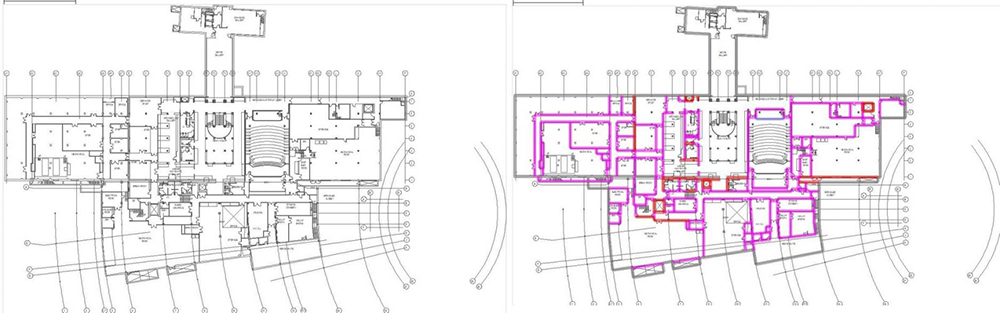
infrastructure outlined according to its effects on WiFi signal.
Higher education was the earliest market to advocate for wireless network design. After introducing WiFi in residence halls, universities tracked how students started to use the data and noticed a drop in wired data vs. wireless usage, revealing the residence halls were going to require robust WiFi coverage to keep up with future demands. As those students started to trickle into the workforce, the need for wireless was everywhere and becoming more apparent to all markets.
The first step in WiFi design is a programmatic meeting with the owner’s IT department, collecting data in order to understand the needs, capabilities, and expectations of the project’s network. Predictive modeling software enables the interpretation of the buildings’ characteristics – including one and two hour walls, mechanical and plumbing chases, concrete walls and foundations, block and glass walls, metal and wood doors, etc. Each of these can impact WiFi reception within a given room. For instance, two hour rated walls and metal materials tend to block more signal, while one hour rated walls and wooden materials tend to be more forgiving. Glass, depending on the type, can impact how far a WiFi signal can reach. For example: Energy efficient glass can act as a barrier for WiFi.
Starting with a floor plan, the building materials for the facility in question are assigned a decibel attenuation value. This value changes in color according to the materials’ abilities to block WiFi signal. These statistical values are then traced on top of the floor plan creating a colored heat map illustrating the device’s radio frequency energy, how it travels, and where the loss of signal occurs. The interior of this building is a bright, blue-green hue, indicating robust WiFi signaling throughout the facility. Thanks to wireless heat maps, it is possible to stop crossing your fingers when it comes to WiFi coverage, freeing your digits to keep scrolling, swiping, and tapping along with the rest of the Internet.
Jay Epstein is principal at Acentech, Cambridge, Mass.
MORE FROM Owners Developers & Managers
Cathartes and Tidemark set to open first phase of Marlo on Mill Pond
Portsmouth, NH According to Cathartes and Tidemark, the first of new luxury waterfront apartment homes will become available this fall in the city’s West End. Located at 75, 85 and 95 Addorio Way, Marlo on Mill Pond will feature 151 studio,





Quick Hits


Columns and Thought Leadership

Retail infill strategy to activate Pawtucket’s Conant Thread District - by Gaetan Kashala
Until recently, the Conant Thread District consisted of approximately 150 acres of underutilized industrial land spanning Pawtucket and Central Falls. Today, the area is one of the most significant

IREM president’s message: Our new reality - Staying ahead of supply chain delays - by Yoany Vargas
Supply chain delays are slowing construction, ratcheting up operating costs, and extending turnover timelines across Greater Boston, directly reducing revenue and increasing the workload for multifamily and

The legislature has spoken: New Hampshire doubles down on housing in commercial zones - by John Sokul
Last year, the New Hampshire Legislature enacted HB 631, a landmark housing measure requiring municipalities to permit multifamily housing in commercially zoned districts. The law generated

Revitalized Town Centers: Retail??? - by Carol Todreas
It is now widely accepted that customers want to shop in person at physical stores. Brands know that they do better business in a physical store than just on line so they want to open stores. Demand for retail space by digital merchants, local entrepreneurs, and newly developed national chains