

 (1).png)


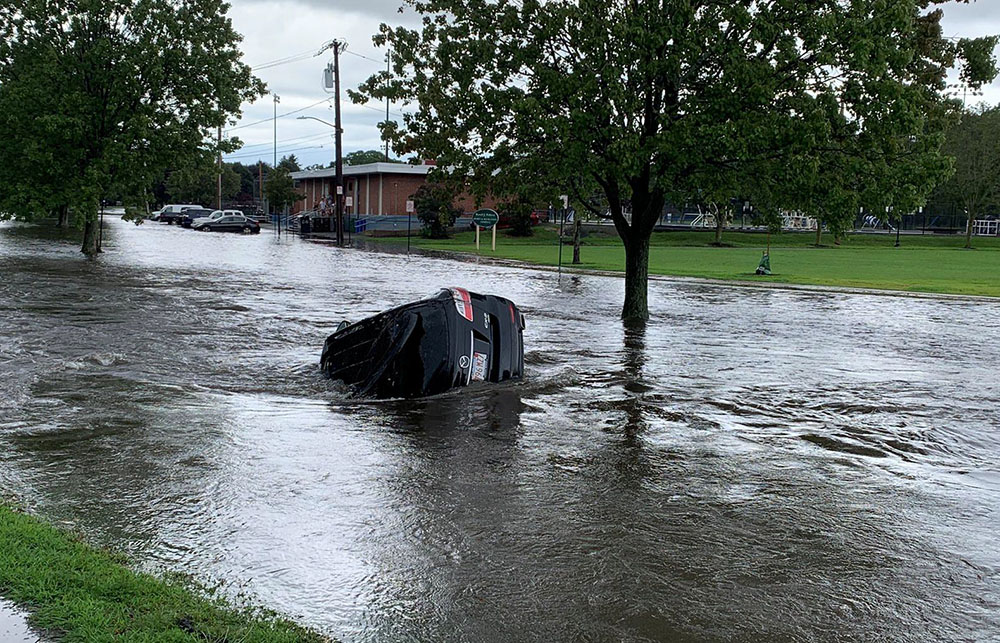
If you live in Newton, you may remember that unforgettable moment in 2021 when a car was swept away by Cheesecake Brook during a flash flood. For many, it was a startling reminder that this small, often-overlooked brook can quickly turn dangerous when heavy storms hit. For city leaders and environmental advocates, it reinforced what they’ve known for years - Cheesecake Brook needs help.
A tributary to the Charles River, Cheesecake Brook’s problems have wider impacts. For over a century, the brook has been forced into pipes and concrete channels that are often too small, cutting it off from its natural floodplain. This has led to worsening floods, pollution, and habitat loss. Following the 2021 flood, a coalition of watershed municipalities, the Charles River Watershed Association (CRWA), Communities Responding to Extreme Weather (C.R.E.W.), Weston & Sampson, and local residents identified Cheesecake Brook as a priority through the Charles River Climate Adaptation Flood Mitigation Implementation Plan. Modeling made clear that without action, communities like Newton would face more severe flooding as climate change drives stronger storms.
For commercial and residential property owners and developers in Newton and surrounding communities, the Cheesecake Brook resilience work has direct implications for property value retention. With FEMA flood maps expected to tighten in coming years, projects like the one at Albemarle Field reduce local flood risk, help stabilize insurance costs, and protect residential and commercial assets within the brook’s drainage area.
From Crisis to Opportunity: The Albemarle Field Project
Recognizing the urgency of these challenges, the city of Newton turned to Albemarle Field, the city’s most significant athletic complex and a direct neighbor to Cheesecake Brook. Building on previous planning efforts, the city and its partners seized the opportunity to integrate climate resilience with much-needed recreational upgrades, ensuring the park is welcoming and sustainable for everyone. Guided by community input, the project introduces:
• Enhanced ball fields;
• A new multipurpose synthetic turf field;
• Six dedicated pickleball courts and a basketball court;
• New tree plantings and bioretention areas;
• Improved circulation and universal accessibility;
• A modernized irrigation system
• New sports and pedestrian lighting; and
• Streambank restoration of Cheesecake Brook.
Led by the city and CRWA, with design by Weston & Sampson, the project gained broad community support, securing $1.4 million from the Municipal Vulnerability Preparedness (MVP) program, a 2024 Coastal Zone Management (CZM) grant from the Commonwealth of Massachusetts, and $2.1 million from the Community Preservation Program. Now under construction, Albemarle Field stands as a model for integrating stormwater resilience, habitat restoration, and recreational improvements to create a vibrant and sustainable public
Nature-Based Solutions in Action
The Albemarle Field project uses nature-based strategies to manage stormwater, reduce flooding, and improve water quality along a 900 ft. pilot section of Cheesecake Brook, including:
• A subsurface infiltration system beneath Albemarle Field’s synthetic turf (made up of nearly 4,500 high‑capacity water‑storage chambers) captures and filters stormwater before it reaches the brook. By temporarily diverting, storing, and infiltrating stormwater, the system reduces overflow and eases pressure on the Crafts St. stormwater pipes, gradually releasing water back to the main line once the subsurface infiltration system reaches capacity.
• Bioretention basins filled with native plants that absorb runoff, improve water quality, support habitat, and add beauty to the park.
• Re-naturalized streambanks replace asphalt swales with coir logs, native plantings, and live stakes to stabilize banks, slow water, and reconnect the brook to its floodplain.
Together, these solutions mitigate stormwater runoff from a six-acre neighborhood, handling storms up to a 25-year event. The system can hold nearly 50,000 cubic feet of water and slowly releases filtered rainwater back into the brook, improving water quality and reducing pollution downstream in the Charles River.
A Model for the Future
Newton’s approach proves that cities don’t have to choose between flood resilience, clean water, and vibrant public spaces. Albemarle Field demonstrates that these priorities can coexist, setting a precedent for communities looking to tackle climate change with innovative, multi-benefit solutions.
As Massachusetts communities increasingly adopt stricter local stormwater and climate adaptation requirements, Albemarle Field provides a replicable standard for meeting the state’s evolving performance‑based regulations. And by integrating flood protection, ecological restoration, and recreational enhancements, Newton is showing that sustainable urban design isn’t just a possibility, it’s a necessity.
Cassie Bethoney is a landscape architecture practice leader and Amanda Gaal is a project manager II in Weston & Sampson’s Foxborough office. Max Rome is the director of green infrastructure for the city of Boston.
This article was previously published in the BSLA Fieldbook







Supply chain delays are slowing construction, ratcheting up operating costs, and extending turnover timelines across Greater Boston, directly reducing revenue and increasing the workload for multifamily and