


 (1).png)
News:
Owners Developers & Managers
Posted: October 3, 2025
The rise of human-first amenities: Multifamily’s next ROI engine
Boston, MA In an era when residents demand more than stainless steel appliances and an empty fitness center, multifamily operators are discovering that the next leap in value creation isn’t about granite countertops or rooftop decks. It’s about human-first amenities – a new category redefining how communities attract, retain, and delight residents while driving NOI growth.
At the forefront of this movement is Luis Mendonça, CEO of Elite Wellness Amenity Group, who believes the future of multifamily lies not in “stagnant” amenities, but in activated, white-glove, resident-centered wellness experiences. “An unused gym doesn’t move the needle,” Mendonça said. “But a staffed wellness program that engages 70% of your residents, lifts retention, and supports $100–$300 rent premiums? That changes the financial equation of a property overnight.”
From Cost Center to Profit Driver
Traditionally, amenities have been treated as line-item expenses — costly to install, costly to maintain, and rarely differentiated. But as residents prioritize wellness, connection, and community, human-first amenities are emerging as a revenue engine. Elite Wellness Amenity Group has pioneered a model that transforms underused apartment gyms into fully staffed wellness centers — with personal trainers, group fitness, nutrition coaching, and curated events — delivered seamlessly under the property’s brand, and with no CapEx required.
For owners and asset managers, the impact is measurable:
• Rent premiums: +$100–$300+ per unit;
• Renewal lift: Higher lease renewals through deeper engagement; and
• Lease-up velocity: Faster absorption in competitive markets.
A Market in Transition
The timing couldn’t be sharper. Across the Northeast and beyond, developers are racing to differentiate as thousands of new units come online and office-to-apartment conversions accelerate. Operators face a familiar challenge: how do you stand out in a sea of sameness?
“Human-first amenities are the new arms race,” Mendonça said. “Pools and dog parks used to sell leases. Today, residents want a lifestyle. They want wellness. They want experiences that actually improve their lives.”
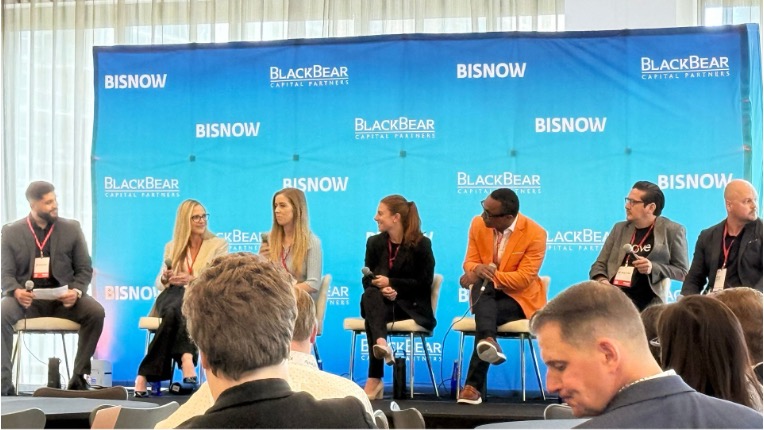
That message is already resonating on the industry’s biggest stages. Earlier this year, Mendonça took the spotlight at the Bisnow Chicago Multi-Regional Conference, where he shared insights on how human-first amenities directly add to property value and strengthen the bottom line. His presentation underscored what many operators are starting to realize: wellness isn’t a perk, it’s a profit center.
The Visionary Behind the Movement
Mendonça’s own journey makes the story even more compelling. An immigrant entrepreneur who built Elite Home Fitness into a multi-state in-home training company, he saw firsthand how wellness drives loyalty, trust, and transformation. That insight led him to bring the same philosophy into multifamily real estate.
Now, Elite Wellness Amenity Group is positioning itself not just as a service provider, but as a category creator — one that is flipping the industry’s view of amenities from static perks to scalable NOI drivers.
Looking Ahead
With pilot programs rolling out in Boston, New York, and Chicago, and conversations underway with some of the nation’s largest operators, Mendonça sees “human-first amenities” as more than a trend — he sees them as the new standard of living.
“The future of multifamily belongs to the properties that don’t just give residents space — but give them people, experiences, and wellness,” he said. “That’s where retention is won. That’s where value is created. And that’s where the industry is heading.”
MORE FROM Owners Developers & Managers

The Lodge at Spruce Peak recognized with Condé Nast Traveler’s 2026 Readers’ Choice Award - #3 in New England
Stowe, VT Condé Nast Traveler revealed the results of its annual Readers’ Choice Awards, with The Lodge at Spruce Peak recognized as the #3 U.S. Resort in New England.





Quick Hits
 (1).png)

Columns and Thought Leadership

IREM president’s message: Our new reality - Staying ahead of supply chain delays - by Yoany Vargas
Supply chain delays are slowing construction, ratcheting up operating costs, and extending turnover timelines across Greater Boston, directly reducing revenue and increasing the workload for multifamily and

Retail infill strategy to activate Pawtucket’s Conant Thread District - by Gaetan Kashala
Until recently, the Conant Thread District consisted of approximately 150 acres of underutilized industrial land spanning Pawtucket and Central Falls. Today, the area is one of the most significant

The legislature has spoken: New Hampshire doubles down on housing in commercial zones - by John Sokul
Last year, the New Hampshire Legislature enacted HB 631, a landmark housing measure requiring municipalities to permit multifamily housing in commercially zoned districts. The law generated

Revitalized Town Centers: Retail??? - by Carol Todreas
It is now widely accepted that customers want to shop in person at physical stores. Brands know that they do better business in a physical store than just on line so they want to open stores. Demand for retail space by digital merchants, local entrepreneurs, and newly developed national chains