



News:
Construction Design & Engineering
Posted: July 15, 2016
Wayne J. Griffin Electric continues work on Terminals C & E at Logan International Airport
Boston, MA The Mass. Port Authority (Massport) is overseeing yet another improvement to the Boston Logan International Airport, where Terminal C is undergoing a significant renovation. The 45-year old terminal, currently home to JetBlue Airlines, is welcoming a new 72,000 s/f addition and renovation, in order to expedite the flight check-in process, create ease in navigating the terminal, and offer additional options for dining and shopping while at the airport.
 Terminal C at Logan International Airport - Boston
The Wayne J. Griffin Electric team, under the direction of senior project manager, Tom Donahue and foreman John Allen and Tyler Dubois, along with telecom division manager Keith Sanborn, telecom project manger Scott Keenan, and telecom foreman Daniel Hume, has been working extended hours in order to ensure the terminal is fully functional while flights are in operation. All power and lighting systems are being renovated by Wayne J. Griffin Electric, offering 277/480v distribution and 120 amp normal power, in addition to the terminal’s access control and CCTV systems.
In order to perform the required wiring to upgrade Terminal C, shutdowns of electrical substations occurred from midnight to 4am daily for six nights, between the time flights had suspended for the evening and begun the following morning. While the electrical substations were offline and being upgraded for the renovation of the terminal, the entire facility was powered by temporary generators, which were made operational by the Wayne J. Griffin Electric team during the few hours in which the airport was closed. Detailed safety planning had to take place in order to ensure the shutdowns would happen without issue. Wayne J. Griffin Electric’s senior project manager Tom Donahue and safety manager John Foody worked directly with Massport’s facilities department, the construction manager and electrical engineer in a coordinated effort to verify, task plan and manger safety of the required shutdowns. Each night, as Wayne J. Griffin Electric’s work was to commence, a lengthy planning meeting took place between all on-site Wayne J. Griffin Electric team members, to go over safety procedures and the required scope of work.
Although the substation upgrades in Terminal C have been completed, Wayne J. Griffin Electric is still on-site, installing ACS security, emergency power and backup generator systems. The Wayne J. Griffin Electric team was also recently contracted to run and pull conduit and data bale below the airport through confined underground tunnels, in order to update and relocated kiosk stations and Digital Passenger Information Program (DPIP) amenities for the Terminal’s upgrade project. Taking place daily for one week, the electrical crew had to access the highly secure crawl spaces with Terminal C, which required confined space training and pre-planned safety measures before taking place. Since the work occurred during the airport’s normal operation hours, the access sites to the underground areas were heavily barricaded, to shield the public from harm, and secured on ground level while a Wayne J. Griffin Electric team member was performing the underground work. The Wayne J. Griffin Electric safety team, working directly with Griffin Electric’s on-site crew, project manager, Gilbane’s safety team and Massport, created a detailed work plan. Each time underground work was to be performed, t was carefully planned and scheduled with considerable advance notice, maintaining the airport’s security.
Construction management firm, Gilbane Building Co. is overseeing the project, working alongside, AECOM, and electrical engineer, Parsons Birinkerhoff.
The tenant space portion of the project was completed in December, while the remainder of the project was completed in May.
 Terminal E at Logan International Airport - Boston
In addition to the Terminal C upgrade at Logan, the Griffin team has been contracted to perform the electrical work on the Terminal E renovation project, which includes 95,000 s/f of new construction and renovations. This project serves to reconfigure three gates in Terminal E, the terminal for international flights, in order to make room for the Airbus 380, the largest commercial aircraft, which is 16 feet taller and 50 feet wider than a 747. New two-level boarding bridges are being constructed, along with upper departure-level holding rooms and deplaning areas, in order to accommodate the double-decker aircraft. The terminal’s existing Immigrations and Customs area is also being upgraded as part of this project.
Utilizing BIM technology, the Griffin team is installing switchgear, cable tray and fixtures within the updated areas. Systems for UPS, generator, tele/data, CCTV, access control, fire alarm, lighting protection and public address are also being setup by Griffin. In order to power the area’s 15kv medium voltage infrastructure, the Griffin team is installing a new electrical substation, while an existing substation is undergoing upgrades to accommodate the Terminal’s expansion. The on-site team is being manager by senior project manager, Tom Donahue and foreman Mike Catorio, with the telecommunications work being overseen by telecomm project manager Scott Keenan and telecom foreman Daniel Hume.
Construction management firm Suffolk Construction Co. is working directly with Massport on this project. In addition to architect AECOM and electrical engineer ARORA. The project is expected to be complete by early 2017.
MORE FROM Construction Design & Engineering
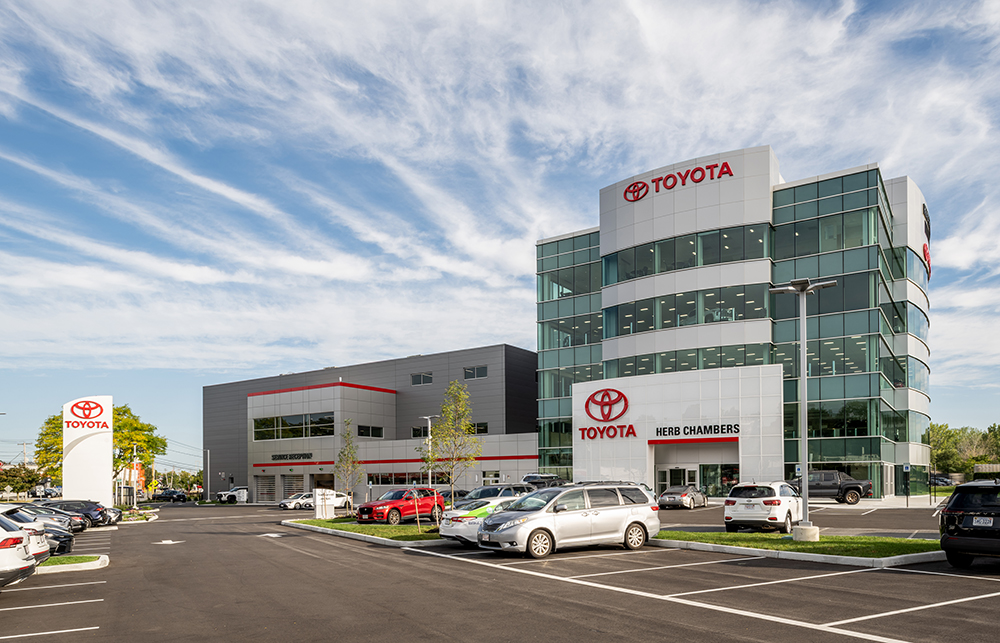
A CM&B project feature: Why dealers are looking beyond vacant land - The repositioning strategy behind Herb Chambers Toyota of Boston
Medford, MA When a five-story former bank headquarters along I-93 became one of Greater Boston’s largest Toyota dealerships, it signaled a broader shift in commercial real estate. It offered a glimpse into where the next generation of dealership growth may come from: opportunities hiding in plain sight within underutilized office and retail properties.






Columns and Thought Leadership

Navigating tariffs and material uncertainty in today’s construction market - by Karl Ginand and Tiffany Gallo
As headlines around tariffs seem to dominate the news daily, many considering construction projects have anticipated major cost escalations and widespread supply issues. While tariffs haven’t driven pricing spikes to the extent once feared, the lasting impact has been a new layer of uncertainty, affecting more than just budgets.

Greenwood Credit Union City Hall Plaza nears completion - by Frank Picozzi
After several years of planning, construction, and anticipation, the community is eagerly awaiting the opening of the Greenwood Credit Union City Hall Plaza and outdoor skating rink later this month.

ABC-Mass. chairman’s message: Rent control isn’t the answer to our housing crisis - by Luiza Mills
As you may know, Massachusetts voters will be weighing in on a number of ballot initiatives in November. Among them is a proposal to impose the nation’s strictest statewide rent control policy. I’d like to tell you why the ABC MA Board

Breathing easier: Elevating indoor air quality and performance in New England commercial spaces - by David Capra
cross the New England commercial real estate landscape, from urban life sciences hubs in Greater Boston to academic research facilities throughout the region, the metrics defining high-performing buildings are shifting. Tenants, developers, and facility owners are placing a renewed focus on an invisible yet vital asset: indoor air quality (IAQ).
