


 (1).png)
News:
Owners Developers & Managers
Posted: December 2, 2016
Community associations remain popular with homeowners
Boston, MA Homeowners associations are preferred places to call home for millions of Americans, according to the “2016 Homeowner Satisfaction Survey,” national research conducted by Zogby Analytics for the Foundation for Community Association Research (FCAR). The majority, (66%) of respondents said their association’s rules protect and enhance their property values, while 84% of those surveyed said members of their elected governing board “absolutely” or “for the most part” serve the best interests of their communities.
The group of randomly selected association residents were asked to rate their experience on a scale of one to five, with one being very bad and five being very good. 65% say they are “very” or “somewhat” satisfied, with 22% neutral and just 13% expressing any level of dissatisfaction.
Community association residents expressed other association benefits: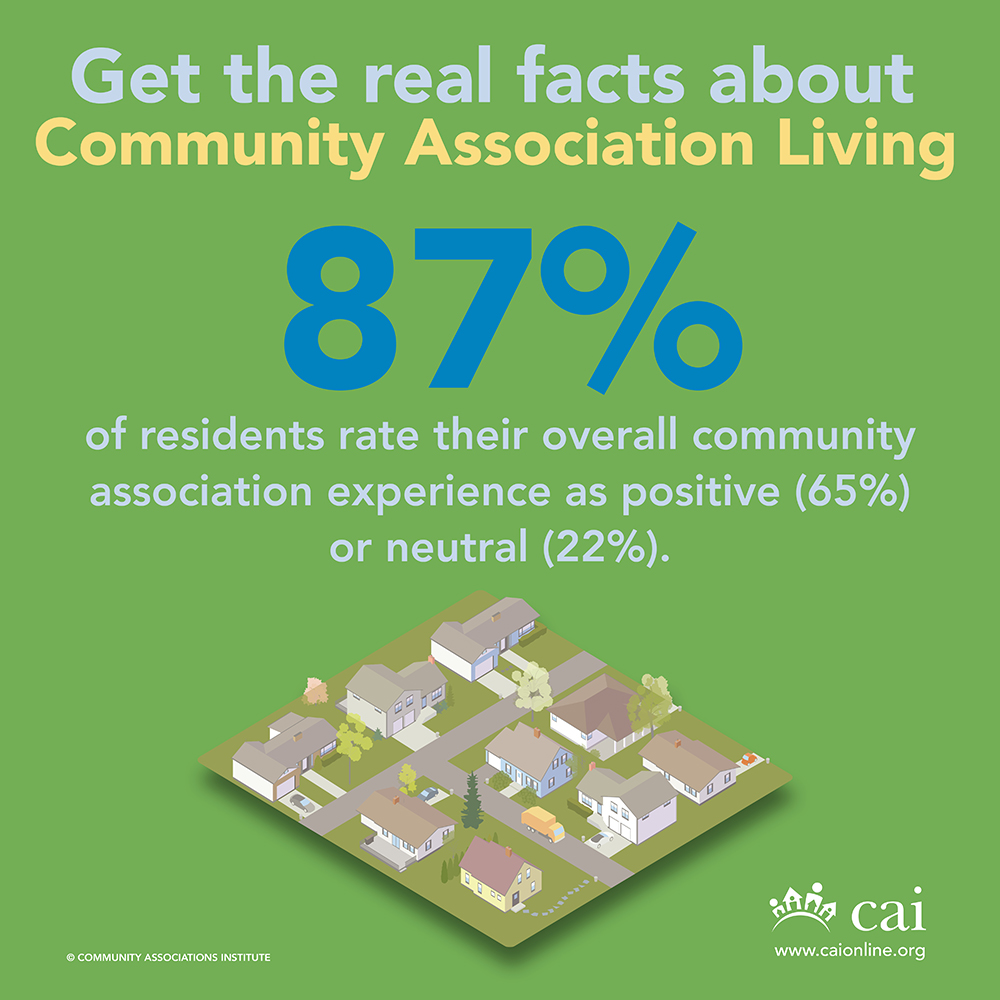
• Nearly 70% of residents said their community managers provide value and support to residents and their association.
• More than 80% of residents who had direct contact with their community manager report a positive experience.
• Two-thirds (67%) of residents said community associations provide excellent value. Those residents also believe they pay about the right amount–some even say too little–in association assessments, versus paying too much.
“A large majority of Americans who live in community associations are happy and satisfied in their communities,” said CAI chief executive officer Thomas Skiba, CAE. “This is a testament to how much the community association model has evolved in recent years. The concept has grown up, become well established and become an increasingly successful form of community governance and an essential component of the U.S. housing market.”
68 million Americans live in 338,000 common-interest communities, from city-sized, master-planned communities and multi-building condominium complexes to urban cooperatives and small homeowners associations built into small tracks of open suburban spaces. Survey findings also showed that homeowners want to see less, or at least not more, government oversight and control of community associations.
Foundation for Community Association Research conducted similar surveys in 2005, 2007, 2009, 2012, and 2014. Results can be accessed at http://cairf.org/research/survey_homeowner_past.aspx.
Foundation for Community Association Research (FCAR) was founded in 1975. FCAR is a 501(c)(3) organization that supports and conducts research and makes that information available to those involved in association development, governance and management. FCAR provides authoritative research and analysis on community association trends, issues and operations. Their mission is to inspire successful and sustainable communities. They sponsor needs-driven research that informs and enlightens all community association stakeholders—community association residents, homeowner volunteer leaders, community managers and other professional service providers, legislators, regulators and the media.
Community Associations Institute (CAI) is a national nonprofit 501(c)(6) organization founded in 1973 to foster competent, responsive community associations through research, training and education. CAI is a membership organization dedicated to building better communities. With more than 34,000 members, CAI works in partnership with 60 chapters around the country. They work to identify and meet the evolving needs of the professionals and volunteers who serve associations, by being a trusted forum for the collaborative exchange of knowledge and information, and by helping their members learn, achieve and excel. Their mission is to inspire professionalism, effective leadership and responsible citizenship—ideals reflected in associations that are preferred places to call home.
MORE FROM Owners Developers & Managers
The Lodge at Spruce Peak recognized with Condé Nast Traveler’s 2026 Readers’ Choice Award - #3 in New England
Stowe, VT Condé Nast Traveler revealed the results of its annual Readers’ Choice Awards, with The Lodge at Spruce Peak recognized as the #3 U.S. Resort in New England.





Quick Hits


Columns and Thought Leadership

The legislature has spoken: New Hampshire doubles down on housing in commercial zones - by John Sokul
Last year, the New Hampshire Legislature enacted HB 631, a landmark housing measure requiring municipalities to permit multifamily housing in commercially zoned districts. The law generated

IREM president’s message: Our new reality - Staying ahead of supply chain delays - by Yoany Vargas
Supply chain delays are slowing construction, ratcheting up operating costs, and extending turnover timelines across Greater Boston, directly reducing revenue and increasing the workload for multifamily and

Revitalized Town Centers: Retail??? - by Carol Todreas
It is now widely accepted that customers want to shop in person at physical stores. Brands know that they do better business in a physical store than just on line so they want to open stores. Demand for retail space by digital merchants, local entrepreneurs, and newly developed national chains

Retail infill strategy to activate Pawtucket’s Conant Thread District - by Gaetan Kashala
Until recently, the Conant Thread District consisted of approximately 150 acres of underutilized industrial land spanning Pawtucket and Central Falls. Today, the area is one of the most significant