


 (1).png)
News:
Owners Developers & Managers
Posted: February 17, 2023
Law purchases Vanderbilt Berkshires Estate for redevelopment - 89 acres, 55,000 s/f
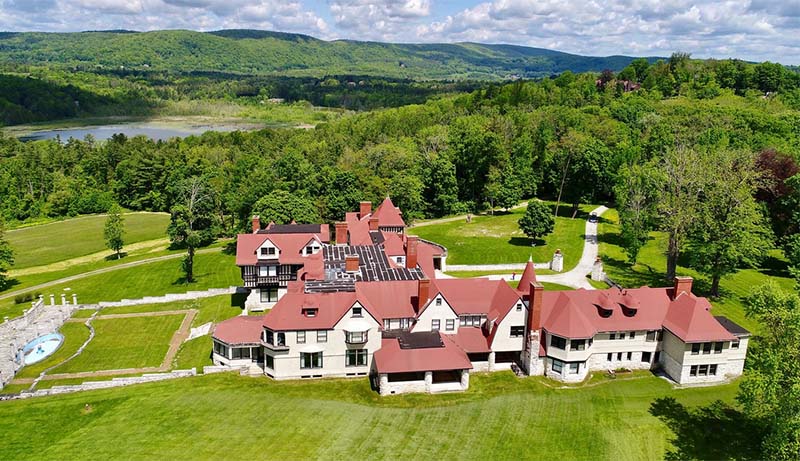
Lenox, MA Linda Law of Law & Associates, a real estate developer and investor who formerly owned the gilded-age Blantyre Estate in Lenox, has purchased the Vanderbilt Berkshires Estate (VBE), formerly Elm Court, the largest shingled residence in the United States and one of the few remaining historically significant gilded-age mansions in the Northeast.
The 89-acre estate, which spans the cities of Lenox and Stockbridge, was designed in 1885 as a summer residence for Emily Vanderbilt and her husband William Sloane. Its grounds were designed by Frederick Law Olmsted, the ‘father of landscape architecture’ who also designed New York City’s Central Park and the U.S. Capital. There are additional residences and amenities on the property, including stables and greenhouses.
Law and her business partner, Dr. Rick Peiser, professor of real estate development at the Harvard University School of Design, are exploring alternative concepts for VBE. One of which is a luxury resort, with Law in discussion with several operators. The estate is fully entitled for 112 guestrooms, as well as a 15,000 s/f spa and a 60-seat restaurant.
“While this grand Berkshire estate is suitable for a country retreat, we are not yet certain what the next incarnation of this legacy property will be. But what we do know is that our team is going to be very deliberate in its thoughtful renovation to restore the vibrancy of this treasured landmark,” said Law. “Collectively, we have done a tremendous amount of research on the architecture and design of the Gilded Age and the history of the Vanderbilt family, and we feel a tremendous responsibility to pay homage to its legendary past,” she said. “Equally as important, we will pay the utmost attention to the historical importance of Elm Court as its own entity, as well as its position and prominence in the Lenox and Stockbridge communities.”
A Storied History
Elm Court was designed in 1885 by premier architects Peabody and Sterns as a summer residence for Vanderbilt and her husband, Sloane. The Sloanes, who had five children, aimed to build a modest home. However, at the end of 1885, Emily’s father, railroad tycoon William Henry Vanderbilt, died suddenly, leaving each of his eight children $10 million. With money no longer a factor, the plans for the home changed as the family expanded. The grounds were designed by Frederick Law Olmsted, the “father of landscape architecture” and the landscape architect of New York’s Central Park and the U.S. Capital. It took 13 months, some 70 designs for Olmsted to plan the property’s gardens.
Like other large residences in fashionable Lenox, Elm Court was, in effect, a private hotel designed as much for the comfort and amusement of friends as for the owners. In high season, a daily schedule of activities was posted in the Manor Hall and might include a lawn tennis tournament, horseback riding, a picnic in a field with silver and servants, and/or an after-dinner concert in the music room staged under crystal sconces and intricate carvings of cherubs. One notable historical anecdote is the fact that the end of World War I was initiated on the terrace at Elm Court through the creation of the Treaty of Versailles and the League of Nations.
In 1948, Vanderbilt descendants began operating an inn (The Elm Court Club) to preserve the estate and provide summer employment for the area’s many teachers. The Inn eventually faltered, and due to overwhelming operational costs, the house shuttered in 1957, and the property was abandoned for 42 years.
During this time the house was passed down through generations, and in 1999, it was passed to Robert Berle, great-great-grandson of the Sloanes, and his wife, Sonya. They undertook more than a $5,000,000 restoration and upgrading effort and opened the property as a luxury Inn. In 2002, the Berle family repositioned Elm Court as a luxury destination for weddings; however, it was too costly to operate, and in 2005, the property was placed on the market with an asking price of $21.5 million. But was then taken off the market at the end of 2006.
In 2012, the couple sold the estate for $9.8 million to Amstar/Travaasa Experiential Resorts, a collection of destinations, resorts, and spas, ending its 137-year history with the family of Emily Vanderbilt Sloane White. Travaasa spent ten years and more than $20 million procuring land use entitlements for a luxury 5-star wellness resort. During litigation of the Travaasa project, Travaasa sold their Austin and Maui resorts and decided to sell Elm Court and close down the company.
In 2020, Elm Court was marketed for $12.5 million. With no viable buyers, Travaasa took it off the market at the end of 2021 and was by Law at the end of 2022.
MORE FROM Owners Developers & Managers

The Lodge at Spruce Peak recognized with Condé Nast Traveler’s 2026 Readers’ Choice Award - #3 in New England
Stowe, VT Condé Nast Traveler revealed the results of its annual Readers’ Choice Awards, with The Lodge at Spruce Peak recognized as the #3 U.S. Resort in New England.








Columns and Thought Leadership

Revitalized Town Centers: Retail??? - by Carol Todreas
It is now widely accepted that customers want to shop in person at physical stores. Brands know that they do better business in a physical store than just on line so they want to open stores. Demand for retail space by digital merchants, local entrepreneurs, and newly developed national chains

Retail infill strategy to activate Pawtucket’s Conant Thread District - by Gaetan Kashala
Until recently, the Conant Thread District consisted of approximately 150 acres of underutilized industrial land spanning Pawtucket and Central Falls. Today, the area is one of the most significant

IREM president’s message: Our new reality - Staying ahead of supply chain delays - by Yoany Vargas
Supply chain delays are slowing construction, ratcheting up operating costs, and extending turnover timelines across Greater Boston, directly reducing revenue and increasing the workload for multifamily and

The legislature has spoken: New Hampshire doubles down on housing in commercial zones - by John Sokul
Last year, the New Hampshire Legislature enacted HB 631, a landmark housing measure requiring municipalities to permit multifamily housing in commercially zoned districts. The law generated