



News:
Construction Design & Engineering
Posted: May 1, 2026
Suffolk hosts second annual Climate Tech Forum
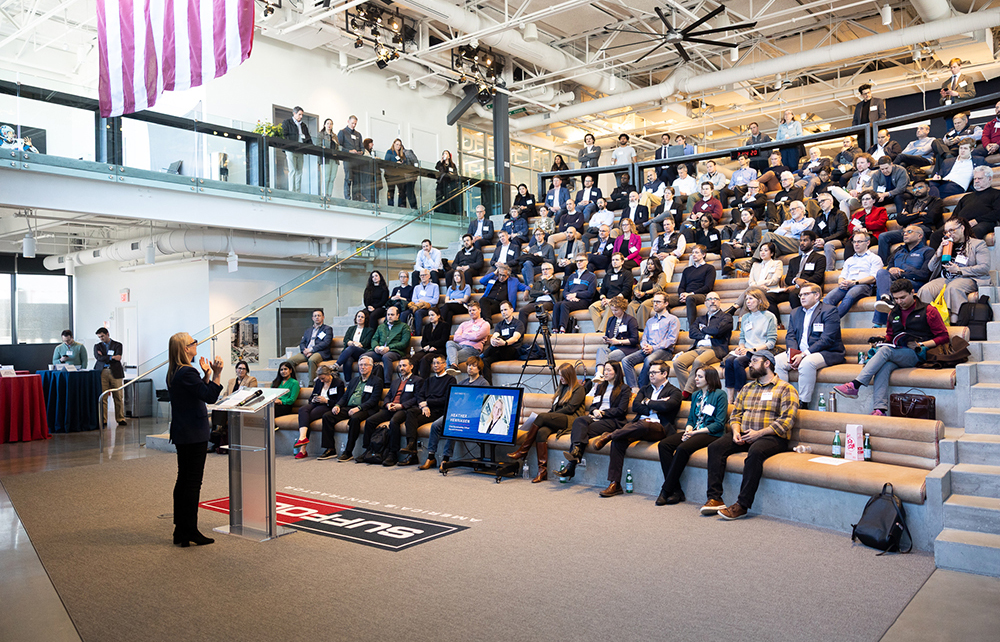
Boston, MA Suffolk hosted its second annual Climate Tech Forum at its local headquarters. The event, co-hosted by Suffolk’s Sustainability Group and Suffolk Technologies, convened construction industry leaders, climate tech startup founders, investors and institutional partners to explore practical strategies and real-world case studies for accelerating sustainable innovation across the built environment.
This year’s Forum focused on achieving climate technology adoption through three high-impact areas: energy and grid readiness, building performance and materials innovation. By bringing together key stakeholders, the event reflected Suffolk’s sustained commitment to identifying, testing and scaling solutions that can reduce emissions, strengthen resilience and improve outcomes to transform the industry. Breakout discussions highlighted how next-generation technologies can move from pilot to scaled implementation while supporting constructability and operational efficiency.
“The unprecedented interest in this year’s forum reflects how urgently the industry is looking for practical, scalable climate solutions,” said Steven Burke, senior director of sustainability at Suffolk. “At Suffolk, we have the opportunity to help connect innovation with implementation, and we designed this convening to focus on the areas where we see the greatest potential for impact. Bringing together the right stakeholders helps create clearer pathways to pilot, evaluate and scale technologies that can make a tangible difference.”
Heather Henriksen, chief sustainability officer at Harvard University, delivered the keynote address and emphasized that higher education can serve as a testing ground for practical solutions that can be piloted, evaluated and scaled across complex portfolios. Suffolk also highlighted its broader sustainability footprint, noting that the company ranks among the country’s top green contractors and that 67% of its revenue last year incorporated advanced efficiency measures and green technologies beyond standard requirements. Through Suffolk Technologies, the venture capital affiliate of Suffolk that invests in early-stage built world startups, the company has backed more than 60 startups since 2019, several of which presented at the forum.
“The next generation of climate solutions will come from founders rethinking how the built world performs at every level,” said Jonson Berman, vice president, investments and sustainability lead at Suffolk Technologies. “Our role is to identify those breakthroughs early and bring them into the mainstream by pairing investment with real-world application and industry collaboration. Events like this are one way we help catalyze that broader ecosystem and accelerate the path from innovation to adoption.”
Participating companies that pitched their ideas included Thalo Labs, Transaera, AeroShield, Prometheus Materials, Ouros Materials, Infinite Recycled Technologies, Dig Energy, Radiant Nuclear and Luminous, showcasing solutions across building performance, low-carbon materials, circularity, geothermal, portable power and solar robotics. Presentations focused on practical applications that can reduce emissions, improve efficiency and help accelerate adoption across the built environment. The forum also featured case studies focused on implementation, including a planned geothermal pilot at Suffolk’s own Boston headquarters.
Through its continued investments in sustainability, design, technology and innovation, Suffolk is helping advance the next generation of practical climate solutions for the built environment. The Climate Tech Forum reflects the company’s commitment to identifying scalable approaches that can support decarbonization, strengthen resilience and create lasting value for clients and communities.
MORE FROM Construction Design & Engineering

Breathing easier: Elevating indoor air quality and performance in New England commercial spaces - by David Capra
cross the New England commercial real estate landscape, from urban life sciences hubs in Greater Boston to academic research facilities throughout the region, the metrics defining high-performing buildings are shifting. Tenants, developers, and facility owners are placing a renewed focus on an invisible yet vital asset: indoor air quality (IAQ).






Columns and Thought Leadership

Navigating tariffs and material uncertainty in today’s construction market - by Karl Ginand and Tiffany Gallo
As headlines around tariffs seem to dominate the news daily, many considering construction projects have anticipated major cost escalations and widespread supply issues. While tariffs haven’t driven pricing spikes to the extent once feared, the lasting impact has been a new layer of uncertainty, affecting more than just budgets.

ABC-Mass. chairman’s message: Rent control isn’t the answer to our housing crisis - by Luiza Mills
As you may know, Massachusetts voters will be weighing in on a number of ballot initiatives in November. Among them is a proposal to impose the nation’s strictest statewide rent control policy. I’d like to tell you why the ABC MA Board
Breathing easier: Elevating indoor air quality and performance in New England commercial spaces - by David Capra
cross the New England commercial real estate landscape, from urban life sciences hubs in Greater Boston to academic research facilities throughout the region, the metrics defining high-performing buildings are shifting. Tenants, developers, and facility owners are placing a renewed focus on an invisible yet vital asset: indoor air quality (IAQ).

Greenwood Credit Union City Hall Plaza nears completion - by Frank Picozzi
After several years of planning, construction, and anticipation, the community is eagerly awaiting the opening of the Greenwood Credit Union City Hall Plaza and outdoor skating rink later this month.
