


 (1).png)
News:
Owners Developers & Managers
Posted: September 2, 2016
Community Assn. 2015 Fact Book updated with new data
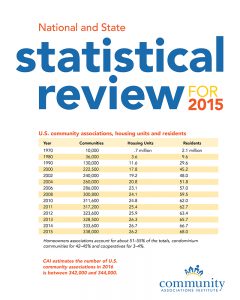 Boston, MA Community Associations Institute’s (CAI’s) Foundation for Community Association Research recently updated its 2015 Community Association Fact Book. In addition to providing historical data on the number of U.S. homeowners associations, condominiums and cooperatives; the number of units in those communities; and the number of people who call them home, the five-part, online PDF also documents the history, status, trends and future issues of U.S. community associations, and includes state summaries and top-level association housing data for other countries.
One of the most notable additions to this year’s Community Association Fact Book is Part Five: Large-Scale Association Survey Results. The Large-Scale Managers Committee of Community Associations Institute, in collaboration with the Foundation, conducted the nationwide study to broadly explore the community, governance and business services provided by large-scale associations (LSAs) to their members and residents. The 150+ page report defines LSAs, which typically have more than 1,000 lots or units and budgets of several million dollars, by five primary-use and lifestyle-theme categories: Age restricted, mixed-use, private club, residential and resort/residential.
The resource also includes housing data for all 50 states and the District of Columbia, including general housing characteristics; age of residents, household type, disability and place of birth; property values and real estate taxes; and mortgage data—with and without a mortgage by age group and compared to national data.
The Fact Book is divided into five parts:
• The National and State Statistical Review for 2015—a summary brochure of key national and state data
• The Community Association Fact Book 2015—comprehensive data and information
• State-level association data and information
• Data on 55+ U.S. condominium owners in each state and the District of Columbia
• Large-Scale Association Survey Results
In addition the Fact Book includes the following:
• A section on community associations in other countries, including a table on general population and housing data
• Data comparing community associations to other entities such as public charities, corporations, partnerships and governmental units
• National Flood Insurance Program data on condominium policies, claims and premiums in all states
• Additional links to Federal Housing Administration programs, including data on cooperatives
• Information on community association lien priority issues and related litigation
• Links to publications, such as Ethics, the Foundation’s latest best practices report; and surveys, such as the most recent national survey of community association residents
The Foundation for Community Association Research provides authoritative research and analysis on community association trends, issues and operations. Its mission is to inspire successful and sustainable communities. The statistics in the free PDF were developed by CAI past president Clifford Treese, CIRMS, president of Association Data, Inc., in Mountain House, Calif.
The fact book and other foundation resources can be downloaded at www.cairf.org
MORE FROM Owners Developers & Managers

Question 3 would build on Rhode Island's economic strengths
At the Quonset Business Park, we’ve seen firsthand what is possible when Rhode Island makes strategic investments in the infrastructure and programs businesses need to grow. This election season, Question 3 on the ballot asks voters





 (1).png)

Columns and Thought Leadership

IREM president’s message: Our new reality - Staying ahead of supply chain delays - by Yoany Vargas
Supply chain delays are slowing construction, ratcheting up operating costs, and extending turnover timelines across Greater Boston, directly reducing revenue and increasing the workload for multifamily and

The legislature has spoken: New Hampshire doubles down on housing in commercial zones - by John Sokul
Last year, the New Hampshire Legislature enacted HB 631, a landmark housing measure requiring municipalities to permit multifamily housing in commercially zoned districts. The law generated

Retail infill strategy to activate Pawtucket’s Conant Thread District - by Gaetan Kashala
Until recently, the Conant Thread District consisted of approximately 150 acres of underutilized industrial land spanning Pawtucket and Central Falls. Today, the area is one of the most significant

Revitalized Town Centers: Retail??? - by Carol Todreas
It is now widely accepted that customers want to shop in person at physical stores. Brands know that they do better business in a physical store than just on line so they want to open stores. Demand for retail space by digital merchants, local entrepreneurs, and newly developed national chains